


A golfer is standing among the trees and spots a gap. His attention immediately moves through the opening towards the fairway or green. The solution seems obvious: he simply needs to play the ball through that gap.
But what the golfer sees at first is only a visible window. The complete concept of playable windows in golf, on the other hand, considers the entire shot trajectory.
Whether that visible opening becomes a playable window can only be judged after the expected ball flight is compared with the entire situation. This includes the lie, start line, launch angle, height profile, the golfer’s normal dispersion and the position in which the ball is expected to finish after landing and rolling.
The finishing area is therefore part of the decision as well. The wider idea of choosing an area rather than one exact point is explained in Playing to zones in golf.
A visible gap therefore answers only the first question:
Where does there appear to be enough room for the ball?
A playable window answers a much broader question:
Can my normal ball flight use this opening with enough margin for error and still create a controllable next playing situation?
We encounter situations like this regularly in our golf lessons in Mallorca. At Capdepera Golf in particular, trees, branches, changes in ground level and uneven lies frequently create visible paths that only become truly playable after closer analysis.
Why visible gaps are so attractive
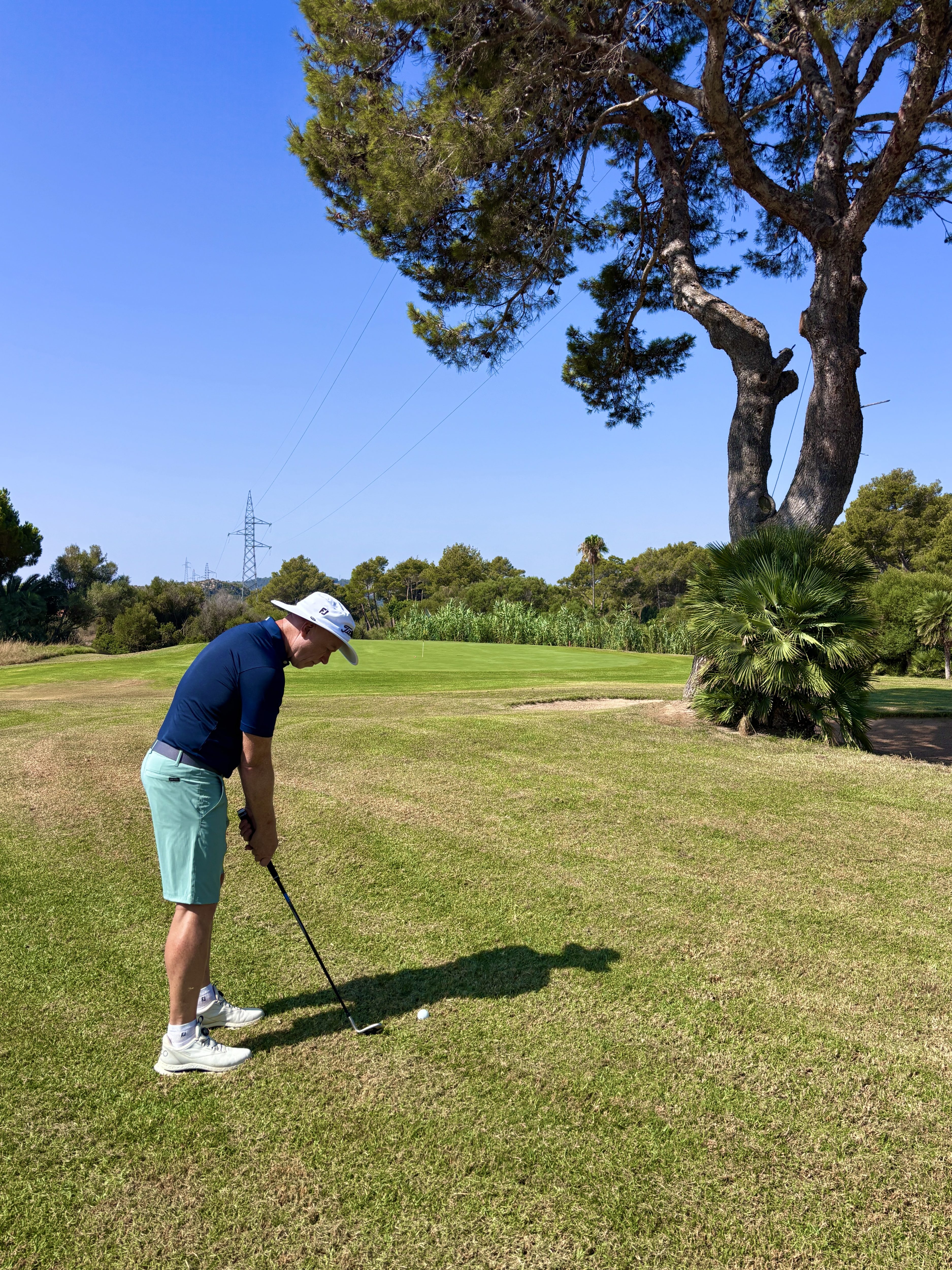
A gap between trees catches the eye. It reveals a direct line back to the fairway or even towards the green. The possible gain in distance is immediately visible, while the risks often appear less obvious.
The golfer sees:
- the open space,
- the possible line towards the target,
- and the advantage of a successful shot.
Less obvious are:
- the actual height of the branches,
- the early part of the ball flight,
- the width of the golfer’s normal shot pattern,
- the consequences of a less-than-perfect strike,
- the landing area,
- the runout,
- and the next ball position.
As a result, a visible opening can easily be mistaken for a playable solution.
Especially in recovery situations, it is easy to think:
If I can get through that gap, I have solved the problem.
But that is only true if the ball remains playable afterwards as well.
At our golf school in Mallorca, we use exactly these situations to broaden the golfer’s perspective. The goal is not only to see the opening, but to understand which information matters before, through and beyond the visible window.
The window must match the golfer’s normal ball flight
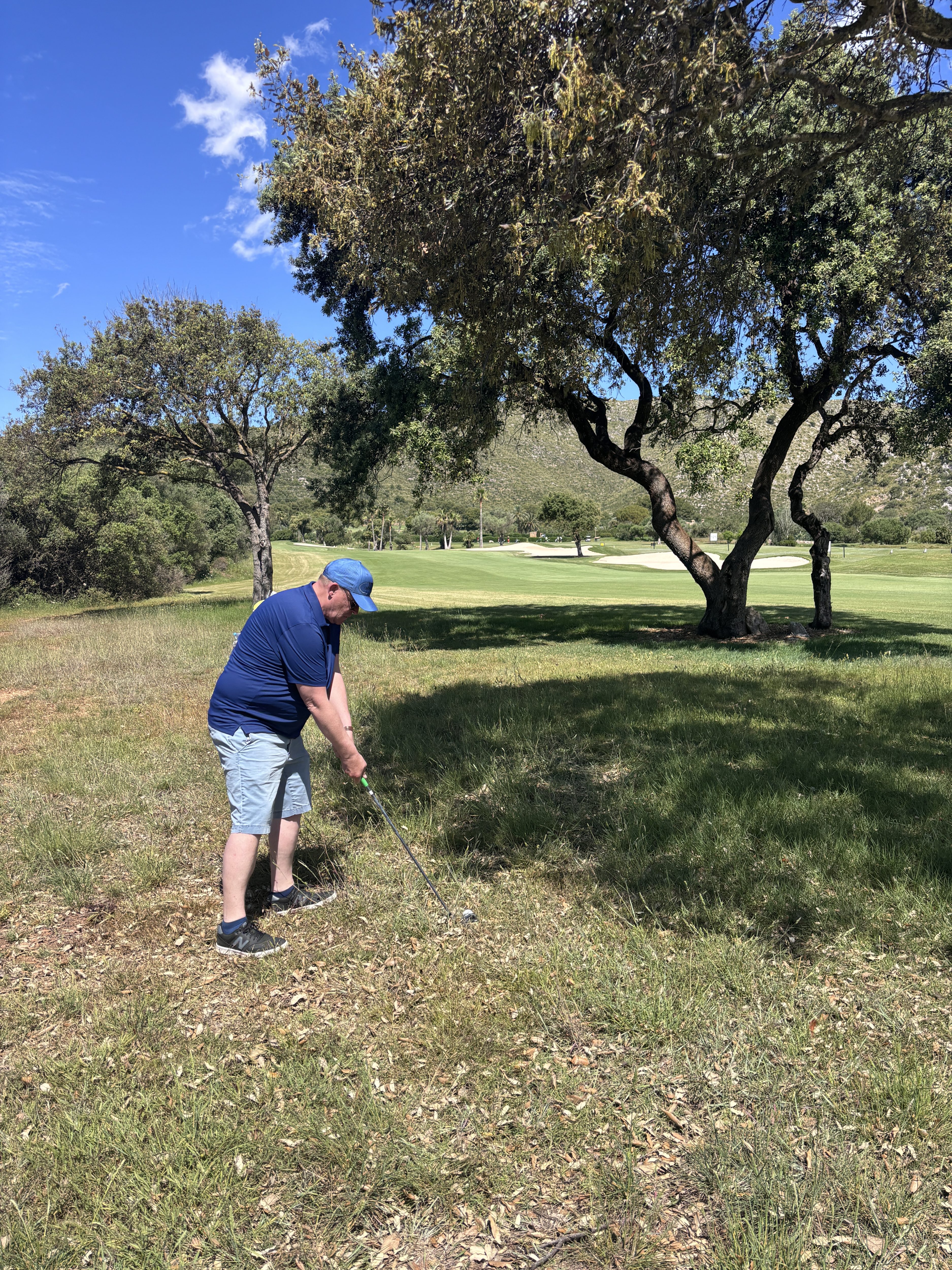
Many golfers unconsciously compare a visible gap with their best possible shot. They picture clean contact, the desired launch angle and exactly the right flight height.
But a good decision should not depend on everything coming together perfectly.
The golfer needs to compare the window with their normal shot pattern and dispersion:
- How much does the start line normally vary?
- How much does launch height vary?
- How stable is the strike from this lie?
- Which side becomes particularly costly when the ball deviates?
- Would a slightly poorer shot still remain playable?
An important part of this is understanding your personal height control and typical ball-flight patterns.
A window that only works with your best strike usually offers too little margin for error.
We look more closely at how normal variation and the possible consequences of a miss should be taken into account in the chapter on safety margin and margin for error in golf.
That does not mean difficult shots should always be avoided. It means that the possible benefit and the realistic chance of success should be assessed together.
In our golf lessons at Capdepera Golf, we let golfers experience these differences themselves. They do not only attempt the desired trajectory, but also observe the variations that actually occur as club selection, strike and speed change.
Key point: A visible window should not be planned around your best shot. It needs to fit your normal ball flight.
The visible size of a window and its playable size are not the same

From the golfer’s perspective, a window often appears larger than it actually is in relation to the ball flight.
The golfer sees open space between two trees. But the ball does not only need room to the left and right. It also needs room above and, in some situations, below.
A window can be restricted by:
- a branch immediately in front of the ball,
- a tree canopy farther along the flight,
- trees or branches to the left and right,
- the rising ball flight,
- a required landing area,
- or a limited runout zone.
A window can therefore look wide at first glance but become very narrow when the actual ball flight is considered.
The question is not simply whether the ball can pass through one particular point. It needs to remain inside the available height corridor throughout the relevant part of the flight.
At Capdepera Golf, we find many natural examples of this. A ball may start underneath the lower branches but later rise into the crown of a tree. In the same way, it may pass through a lateral gap successfully and then roll too far along an unfavourable line on the ground.
The lie affects playability

The visible window remains the same, but the lie can completely change the golfer’s options.
In our article “Why the Same Golf Club Can Produce Different Ball-Flight Heights”, we explain why the same club can produce different trajectories depending on speed, dynamic loft, strike quality and the lie.
From a clean fairway lie, ball flight is usually easier to predict than from semi-rough, rough, a dry lie or uneven ground.
The lie can influence:
- how cleanly the ball can be struck,
- the dynamic loft delivered at impact,
- launch height,
- how much speed is transferred to the ball,
- the resulting trajectory,
- and how the ball reacts after landing.
A shot that would be playable from a good lie may no longer offer enough margin for error from rough or unstable ground.
That is why the golfer should not only ask:
Will the ball fit through the gap?
The golfer should also ask:
Does this lie allow me to produce the ball flight that this gap requires?
That is why, especially in our golf lessons in Mallorca, we do not practise only from perfect lies. We use fairway, semi-rough, rough, dry areas and slopes so golfers can experience how much the same visible window changes when the lie changes.
A playable window does not end behind the tree

A common planning mistake is to think only as far as the end of the visible obstacle.
The ball travels underneath a branch or between two trees. It appears that the problem has been solved. But the ball continues to fly and roll.
It may:
- run across the fairway into the rough,
- finish behind another tree,
- roll into a bunker,
- stop immediately before another obstacle,
- or create a poor angle for the next shot.
The first problem has been solved, but a new one has been created.
A playable window therefore involves more than simply getting through the opening. We explain how landing, roll, runout and the next ball position fit together in the article “Planning the Entire Shot Trajectory in Golf”.
That is why, during our golf lessons at Capdepera Golf, we do not only ask the golfer which club they want to use. We also ask where the ball should land, how far it should roll and in which area it should ideally finish.
Key point: A shot is not automatically playable just because it clears the first obstacle.
Three possible solutions are not necessarily three equally good solutions
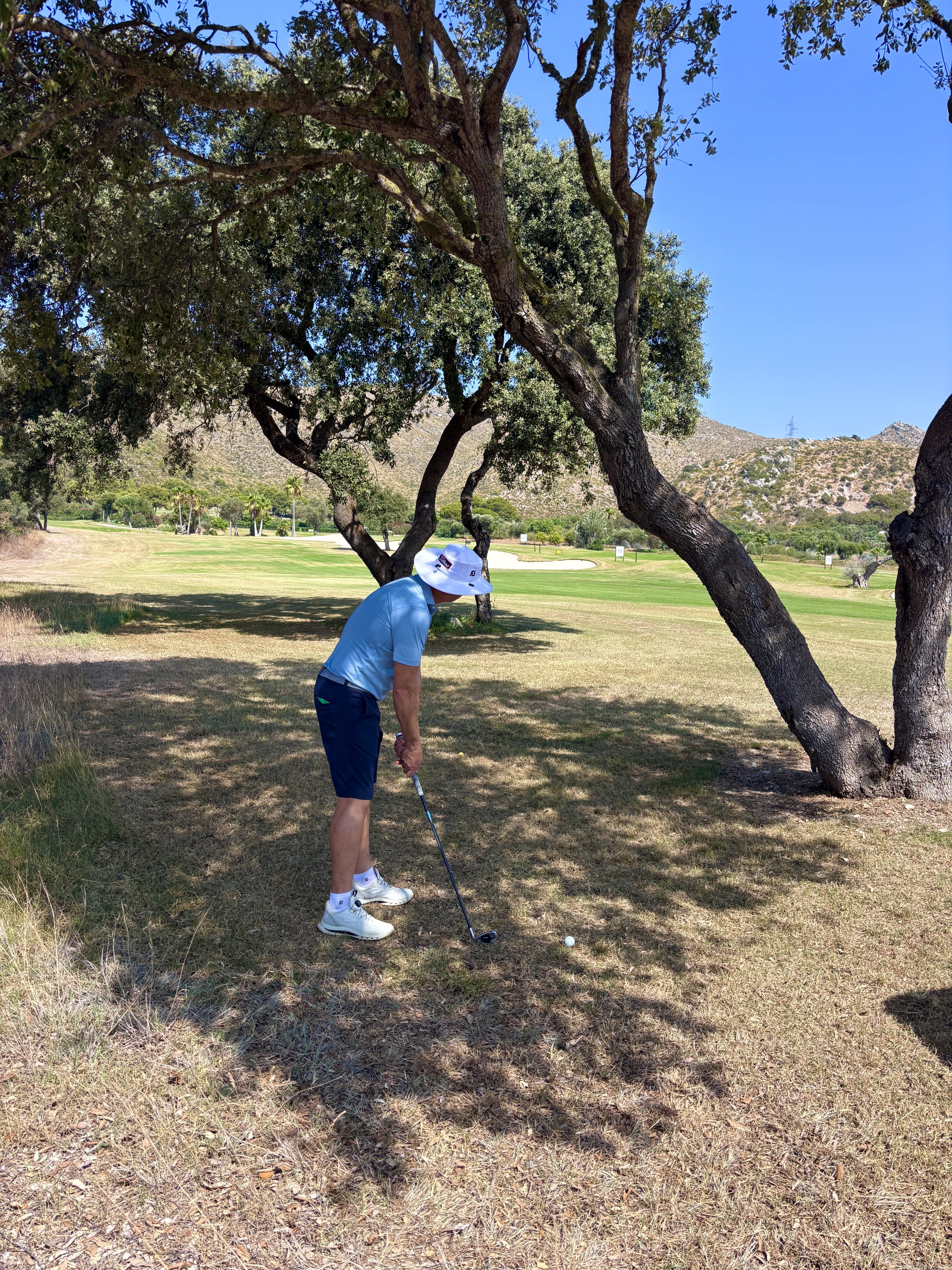
In many playing situations, several lines are available.
For example, a golfer may:
- play the ball safely sideways back onto the fairway,
- play slightly forward and to the side to gain some distance,
- or play as far forward as possible through a narrower opening.
All three options may be technically possible. Their playability, however, can be very different.
The safest option may provide the greatest margin for error but leave a longer next shot. The middle option combines safety with some distance gain. The direct option may offer the biggest reward, but often requires more precise launch, better height control and more reliable strike quality.
The right decision therefore does not depend only on which line is visible. This is part of golf shot planning: defining what the shot needs to achieve, comparing realistic options and considering which position should be created for the next shot. It also depends on:
- how large the potential advantage is,
- how realistically the required ball flight can be produced,
- what happens when the shot deviates from the plan,
- and what playing situation is created afterwards.
This assessment is part of our Strategy Lab. There, we connect available options with ball flight, individual miss patterns, possible consequences and the next playing situation.
In our golf lessons in Mallorca, we deliberately let golfers try different options whenever pace of play and safety allow. This goes beyond a purely theoretical assessment. Golfers can experience for themselves how much the different options vary in flight height, speed, roll and margin for error.
Why golfers often see the more difficult solution first
The direct solution often appears more attractive because its advantage is immediately visible. It saves distance, moves the ball closer to the green or avoids an additional sideways recovery shot.
The safer option, on the other hand, can feel like a step backwards. The golfer deliberately gives up distance and accepts that the next shot will be longer.
But gaining distance does not automatically mean saving shots.
A risky recovery shot may, for example, reduce the next approach from 80 to 50 metres. But if it fails, the ball may hit a tree, be lost or leave another recovery situation.
The key question therefore becomes:
Is the potential advantage large enough to justify the smaller margin for error?
The answer is personal. It depends on the golfer’s skills, normal shot pattern and the specific situation on the course. When a risky shot succeeds, golfers often do not only view the result positively. They may also begin to believe that the decision itself was correct. A single successful outcome can therefore lead to the same low-margin option being chosen again and again in future situations.
Key point: A successful shot does not automatically prove that the decision was good.
At our golf school in Mallorca, we do not try to remove every aggressive option. We help golfers understand when the potential advantage is realistic and when the apparently more defensive option creates a better foundation for the next shot.
How we use these situations in golf lessons

In our golf lessons in Mallorca, we do not only discuss these situations in theory. If the situation on the course and the pace of play allow it, we test several different options.
The golfer begins by describing:
- which windows they can see,
- what kind of ball flight each option requires,
- which danger exists on each side,
- where the ball should land,
- how far it may roll,
- and where the expected finishing position should be.
The different options are then played and compared.
This often reveals that the original assessment was incomplete. The ball starts higher than expected, rises sooner, rolls less or farther, or reacts differently because of the lie.
At Capdepera Golf, we regularly encounter real playing situations like these. They cannot be fully recreated from a neutral practice mat. The golfer has to deal with branches, terrain, grass, ground reaction, wind and normal mishits at the same time.
The golfer therefore does not simply learn one recovery shot. They develop a better connection between perception, prediction, actual ball flight and strategic decision-making.
This combination of golf coaching, on-course practice and individual analysis is an important part of our Golf Learning System. It connects understanding your own ball flight with practical training and better decisions on the golf course.
Compare prediction with reality
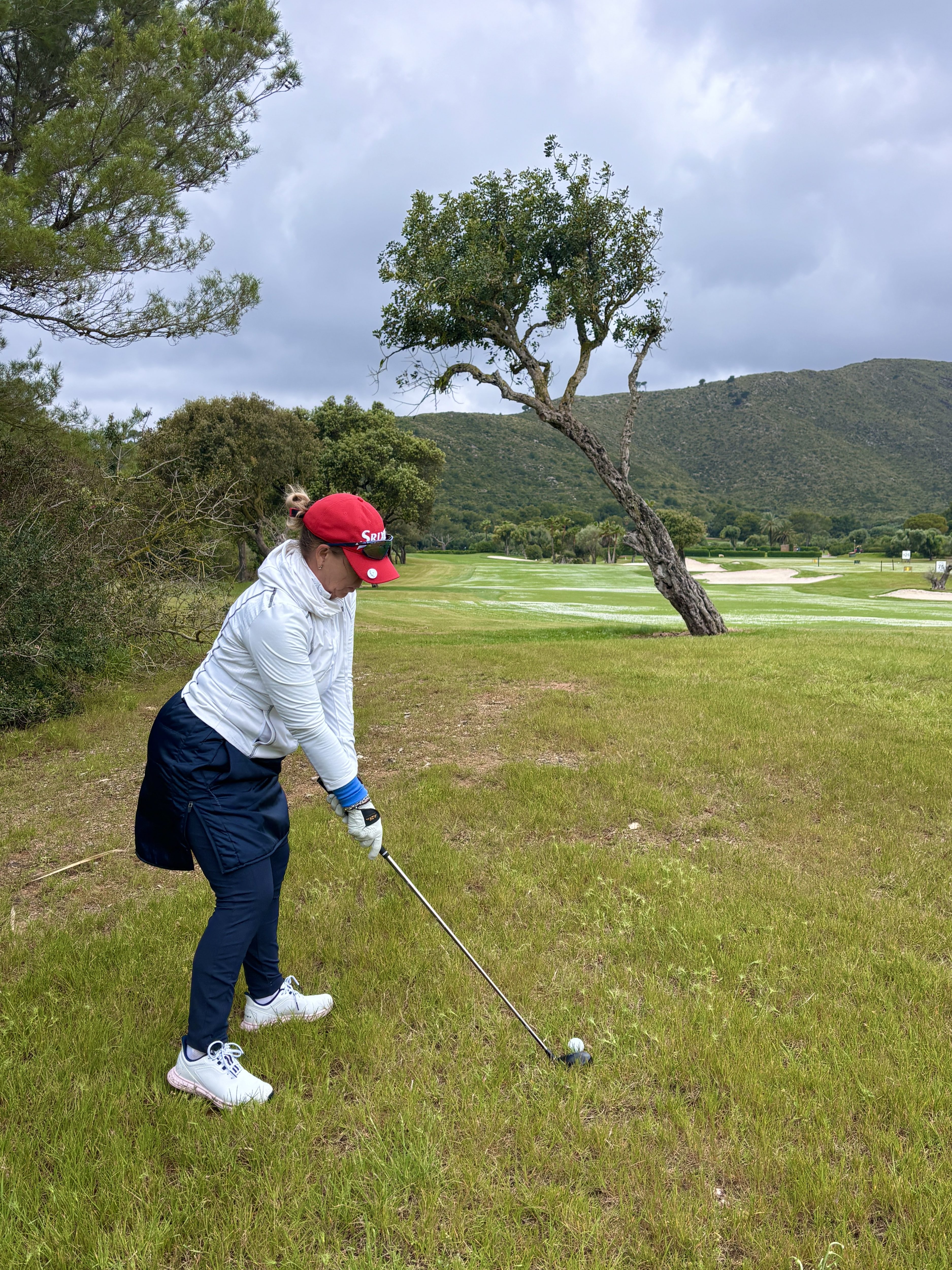
A playing situation becomes particularly valuable for learning when the golfer makes a clear prediction before the shot.
For example:
- The ball starts underneath the first branch.
- It stays low enough until it has cleared the tree.
- It lands short of the fairway target area.
- It rolls into the planned finishing zone.
- A small miss to the right still remains playable.
After the shot, this prediction is compared with reality.
- Was the flight height estimated correctly?
- Did the speed produce the expected amount of roll?
- Was the lie more difficult than expected?
- Was the window really large enough?
- Was the planned finishing position achieved?
This is how a single shot becomes useful learning information.
In our golf lessons in Mallorca, we deliberately allow golfers to test these variations whenever pace of play and safety permit. This goes beyond a purely theoretical judgement. Golfers can experience how much different options really vary in flight height, speed, roll and margin for error.
In the Practice Lab, these ball flights can be observed, tested and compared before the information is transferred to real playing situations.
We explore this learning process in greater depth in the chapter “Comparing Prediction and Reality in Golf”.
For selected exercises, we can also measure ball flight using our portable FlightScope Mevo+. This allows us to compare the golfer’s visual assessment directly with measured ball-flight data.
What turns a visible window into a playable solution?
A visible window shows where there appears to be space.
A playable window is created only when:
- the required ball flight matches the lie,
- the golfer’s normal shot pattern has enough room,
- there is sufficient margin for error,
- landing and runout have been taken into account,
- and the finishing position allows the hole to continue from a controllable situation.
The decisive question is therefore not:
Can I get the ball through there?
But rather:
Is this shot really playable for me from this lie, with my normal variation and a controllable finishing position?
Golfers who learn to answer this question repeatedly do not only develop better recovery shots. They also develop a broader understanding of ball flight, risk and strategy on the golf course.
Learning to distinguish visible and playable windows in golf lessons
The difference between a visible window and a playable window is easiest to understand in real playing situations. Lie, obstacles, terrain and possible landing areas cannot be fully reproduced from a neutral practice mat.
In our golf courses for handicap golfers in Mallorca and in the Strategy Lab, we analyse and test these situations directly at Capdepera Golf.
Golfers do not only learn to recognise an opening. They learn to assess the required ball flight, the available margin for error and the likely finishing position more realistically.
In our article “Integrating Playable Windows into Decisions on the Golf Course”, we explain how ball flight, lie, margin for error and possible consequences come together to form a complete decision.

A visible window offers a possibility. Only when lie, normal variation, margin for error and finishing position are considered can we judge whether it becomes a good decision.
The result: fewer unnecessary chains of mistakes and better decisions on the golf course.
Developed by Michel Monnard
PGA Golf Professional Michel Monnard has more than 30 years of experience in golf instruction, course strategy and ball-flight analysis. He teaches at Capdepera Golf in Mallorca and develops content for the Golf Learning System from real coaching and playing situations.
Basis for this article
This article is based on observations made by Michel Monnard during golf lessons and on real recovery situations at Capdepera Golf. It focuses on the difference between visible and genuinely playable openings, the golfer’s own ball flight and the consequences for landing, roll and the next ball position. The complete training and evaluation framework remains part of personal coaching and the Window Programme.
Contents: Visible windows and playable golf shots
This part of the Playable Windows series focuses on the difference between a visible opening and a truly playable golf shot by combining available space, ball flight, lie, personal ability, safety margin and the position created for the next shot.
- Playable windows in golf
An overview of how visible space, ball flight, height corridors, safety margins and on-course decisions work together. - Visible window and playable window
Why a visible opening only becomes playable when lie, ball flight, personal ability, safety margin and possible finishing position are considered together. - Launch windows and ball-flight height profile in golf
How launch angle, early height development and distance determine whether a golf ball can travel through a restricted opening. - Why the same golf club can produce different ball-flight heights
How dynamic loft, speed, strike location, spin and lie can change the trajectory produced with the same golf club. - Safety margin and margin for error in golf
Why good golf planning needs to allow for normal shot variation rather than relying only on the perfect strike. - How to read height corridors in golf
How upper and lower boundaries, distance, rising trajectory and apex create the three-dimensional space available for a golf shot. - Planning the entire shot trajectory in golf
Why shot planning should include launch, height profile, landing, runout and the position prepared for the next shot. - Comparing prediction and reality in golf
How comparing the expected ball flight with what actually happens improves learning, judgement and future decisions. - Developing personal height control in golf
Why golfers need to understand their own height profiles, normal variation, different club trajectories and the ball flights that are realistically available to them. - Integrating playable windows into decisions on the golf course
How lie, shot pattern, safety margin, consequences and the next playing position determine whether a technically possible shot is also a sensible strategic choice.
For beginner golfers
- How beginners can get back into play from difficult lies
How new golfers can use larger openings, familiar shots and safer target areas to recover from difficult positions and prepare a normal next playing situation.
How the topic connects to our Golf Learning System
- How the Window Programme makes our Golf Learning System visible
How understanding, technical foundations, skill development, Practice Lab, Strategy Lab, technology and on-course transfer combine within one connected learning process.
[booking]


