

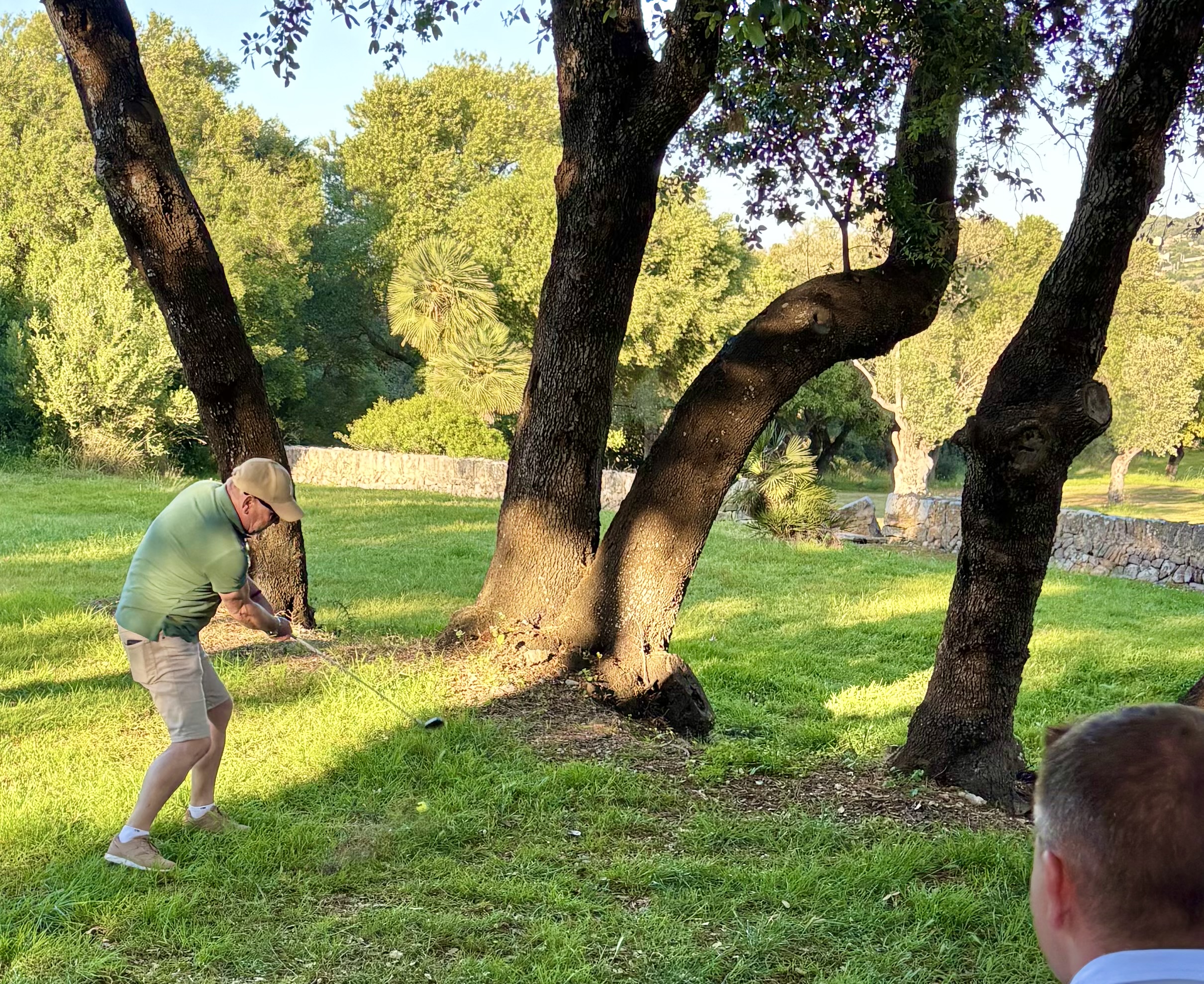
Just because a ball can be played through an opening does not automatically make that shot the best decision.
The ball may be able to pass through a particular opening, while another solution on the golf course may still make more sense.
A good decision needs to consider ball flight, lie, dispersion, possible consequences and the next playing situation together.
A playable window is therefore not an isolated target. It is part of the overall playing strategy.
We explain the foundations of this model in our overview Playable windows in golf.
Technically possible does not automatically mean strategically sensible
A golfer may be able to play a low shot underneath a branch. That does not mean the shot should be used in every situation where it appears possible.
A solution can be technically possible but strategically unfavourable.
This is especially true when:
- the window only fits the very best strike,
- the lie makes clean contact more difficult,
- a small mistake has serious consequences,
- the landing zone is too small,
- or a simpler solution prepares a much better next position.
The question is therefore not only:
Can I play this shot?
But also:
Is this shot the most sensible solution under the current conditions?
The lie changes the playable window

The same visible window can represent a completely different task from two different lies.
A ball on short, level grass can usually be struck with more control than a ball:
- in deep rough,
- on a bare patch,
- on a slope,
- between roots,
- or in a hollow.
The lie influences more than the probability of clean contact. It can also change ball start, height, speed and direction.
A window that appears large enough from a good lie may provide too little margin for error from a difficult one.
Key point: The visible size of the window stays the same. Its actual playability changes with the lie.
We explain in more detail why the same visible opening can be more or less playable depending on the lie in Visible window and playable window.
The normal miss is part of the decision
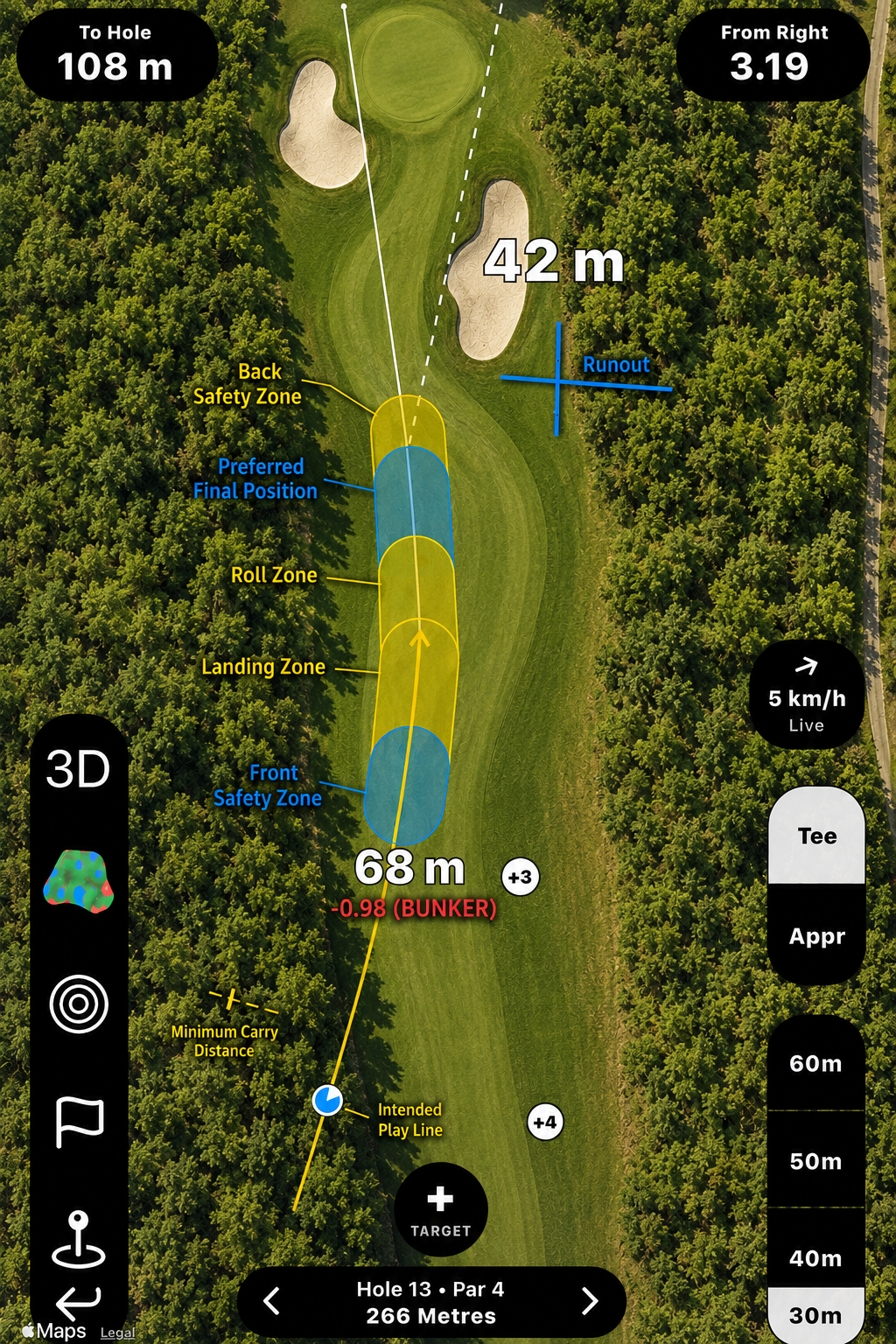
Golfers often plan difficult shots around the intended trajectory.
For a realistic decision, however, the normal miss matters as well.
A normal miss can change height, direction, speed and runout behaviour. Which variations are typical for an individual golfer depends on their personal shot pattern and the lie.
These variations do not need to be eliminated completely. But they should remain playable within the chosen solution whenever possible.
A window is therefore only large enough when it fits not only the ideal trajectory but also the golfer’s likely variations.
We explore how normal variation should be included in planning in Safety margin and margin for error in golf.
The consequences of a miss are not always the same
Two windows of similar size can be strategically very different.
With one window, a ball that flies slightly too high may hit a branch and fall back onto a still-playable area. With another, the same variation may lead to an unplayable lie, out of bounds or a penalty area.
The decision should therefore not be judged only by how likely a miss is. The possible damage caused by that miss matters just as much.
The more serious the possible consequence, the larger the safety margin should become.
Sometimes this means deliberately choosing not to use a visible window.
The finishing position is part of the decision
A successful recovery shot should do more than clear the current obstacle.
It should create a next position from which the golfer can continue with control.
An open area can have very different strategic value. What matters includes:
- whether the next shot has a clear line,
- whether the ball finishes on a controllable lie,
- whether a useful angle towards the next target is created,
- and whether another difficult situation is avoided.
More distance gained does not automatically mean more strategic progress.
A shorter shot can be the better decision if it reaches a wider, safer and more usable finishing position.
We explain how landing, runout and the next ball position should be planned together in Planning the entire shot trajectory in golf.
Simpler solutions are often recognised too late
A visible window attracts attention.
The golfer starts thinking about which club might fit through the opening. This can make another solution easy to overlook.
Perhaps the ball can be played sideways into a wide playing area. Perhaps a shorter shot with more safety margin is available. Or perhaps the obstacle can be avoided in a direction that does not require precise height control.
A good decision therefore does not only compare different clubs within the same window. It also compares different ways out of the situation.
The most spectacular window is not automatically the best solution. During coaching at Capdepera Golf, we therefore compare not only different clubs but also different levels of difficulty and different ways out of the same situation.
Form on the day and pressure change the available solution
A shot that is controllable on a good practice day may not be equally reliable on every day of play.
Fatigue, uncertainty, wind, several poor strikes or the pressure of an important playing situation can increase the golfer’s normal range of variation.
The window itself does not change. But the golfer’s ability to use it with sufficient safety margin can change.
A good decision therefore considers not only what the golfer can generally do, but also which ball flight is realistically available on that day.
Choosing a simpler solution is not a step backwards. It is an adjustment to the real situation.
A good decision can still lead to a poor result
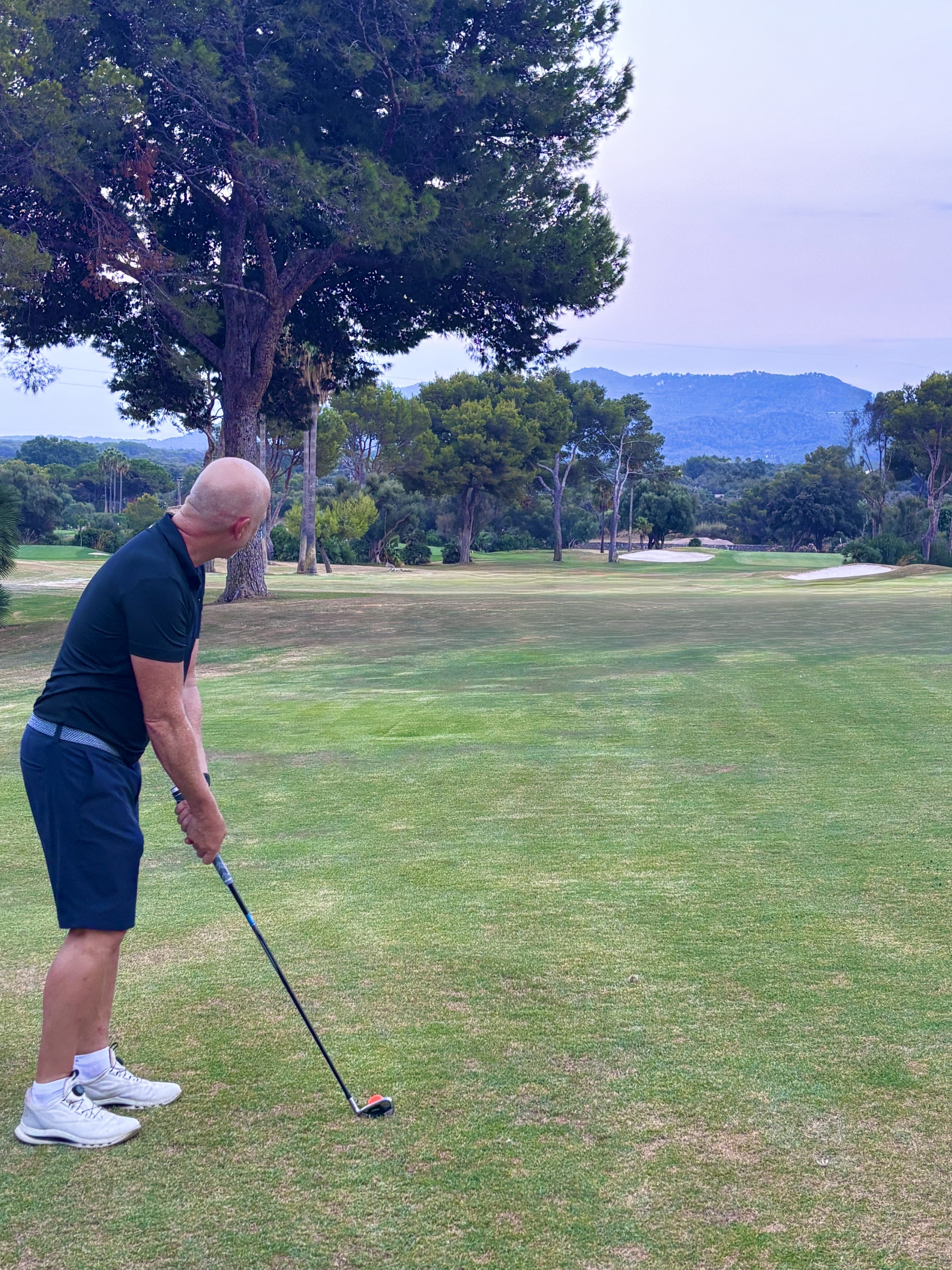
Even a well-planned solution can fail.
The ball may take an unfortunate bounce, be deflected by a branch or, despite sufficient safety margin, start and/or land outside the expected area.
A poor result therefore does not automatically prove that the decision was wrong.
Equally, a risky decision can produce a good result because of an exceptionally good shot.
For learning purposes, decision and result should therefore be assessed separately.
We explore why a good or poor result alone does not prove the quality of a decision in Comparing prediction and reality in golf.
The key question is:
Was the chosen solution sufficiently playable with the information and abilities available?
From a visible window to a complete decision

A playable window is an important part of analysing the situation. But by itself it does not determine which shot should be played.
A complete decision connects the expected ball flight with the lie, typical variations, possible consequences and the next playing situation. Which of these pieces of information matters most depends on the specific situation and the golfer’s personal shot pattern.
This connection is part of our Strategy Lab and our special Window Programme. During coaching, this decision-making process is adapted to the golfer’s personal ball flight, typical variations and real playing situations. This develops an ability that can later be used independently on the golf course.
The aim is not to avoid difficult shots altogether. The golfer should learn to recognise when a demanding solution is sufficiently playable and when a simpler decision offers the better chance.
Integrating playable windows into decisions during golf lessons
Whether a playable window is actually the right solution is best assessed in real playing situations. Lie, personal variation, possible consequences and the quality of the next position together determine whether a technically possible shot also makes strategic sense.
If you would like to experience our training concept yourself, we offer suitable programmes for beginners, experienced handicap golfers and through our Strategy Lab for golfers who want to develop course strategy and decision-making in greater depth.
You do not only learn which shots are technically possible. You learn which solution fits your personal ball flight under the current conditions, provides enough margin for error and prepares a controllable next playing situation.
This connection between ball-flight understanding, personal experience and strategic application is a fundamental principle of our Golf Learning System.
[booking]

A technically achievable window is not yet a complete decision. We connect ball flight, lie, typical variation, possible consequences and the next position.
The result: the golfer recognises not only which shot could be played, but which solution really makes sense under the current conditions.
Professionally developed by Michel Monnard
PGA Golf Professional Michel Monnard has 30 years of experience in golf coaching, course strategy and ball-flight analysis. He teaches at Capdepera Golf in Mallorca and develops the content of the Golf Learning System from real coaching and playing situations.
Basis for this article
This article is based on observations made by Michel Monnard during golf lessons and in real decision-making situations at Capdepera Golf. It focuses on lie, personal variation, possible consequences of a miss, safety margin, finishing position and preparation of the next shot. The personal decision-making process is adapted to the individual golfer during coaching and within the Window Programme.
Contents: Playable windows and golf course decision-making
This part of the Playable Windows series focuses on how a technically possible ball flight becomes an on-course decision by combining lie, personal shot pattern, safety margin, possible consequences, landing and the position created for the next shot.
- Playable windows in golf
An overview of how visible space, ball flight, height corridors, safety margins and on-course decisions work together. - Visible window and playable window
Why a visible opening only becomes playable when lie, ball flight, personal ability and possible finishing position are considered. - Launch windows and ball-flight height profile in golf
How launch angle, early height development and distance determine whether a golf ball can travel through a restricted opening. - Why the same golf club can produce different ball-flight heights
How dynamic loft, speed, strike location, spin and lie can change the trajectory produced with the same golf club. - Safety margin and margin for error in golf
Why good golf planning needs to allow for normal shot variation rather than relying only on the perfect strike. - How to read height corridors in golf
How upper and lower boundaries, distance, rising trajectory and apex create the three-dimensional space available for a golf shot. - Planning the entire shot trajectory in golf
Why shot planning should include launch, height profile, landing, runout and the position prepared for the next shot. - Comparing prediction and reality in golf
How comparing the expected ball flight with what actually happens improves learning, judgement and future decisions. - Developing personal height control in golf
Why golfers need to understand their own height profiles, normal variation and the ball flights that are realistically available to them. - Integrating playable windows into decisions on the golf course
How lie, shot pattern, safety margin, consequences and the next playing position determine whether a technically possible shot is also a sensible strategic choice.
For beginner golfers
- How beginners can get back into play from difficult lies
How new golfers can use larger openings, familiar shots and safer target areas to recover from difficult positions and prepare a normal next playing situation.
How the topic connects to our Golf Learning System
- How the Window Programme makes our Golf Learning System visible
How understanding, technical foundations, skill development, Practice Lab, Strategy Lab, technology and on-course transfer combine within one connected learning process.
[booking]
The Window Programme within the Golf Learning System
How the Window Programme makes our Golf Learning System visible
This concluding article shows how ball-flight understanding, skill development, Practice Lab, Strategy Lab, technology and transfer to the golf course work together within the Golf Learning System.
The strongest message of this chapter is
A playable window answers whether a ball flight is possible. A complete decision answers whether that ball flight also makes sense under the current conditions.


