

Golfers often assess difficult shots only as far as the first visible obstacle.
They ask themselves:
Can I get underneath this branch?
This question matters. But it only describes the beginning of the shot.
After the ball has passed the first obstacle, it continues to fly. It may still be rising, reach its highest point, begin to descend, land and then roll into a new position.
Each of these phases can determine whether a difficult shot becomes a playable solution or creates the next problem. We explain how the ball should be assessed between upper and lower boundaries across several distances in the chapter How to read height corridors in golf.
The key question is therefore not only:
Does the ball fit through the visible window?
But rather:
Where will this ball flight land, run out and eventually finish after passing through the window?
A shot consists of several phases
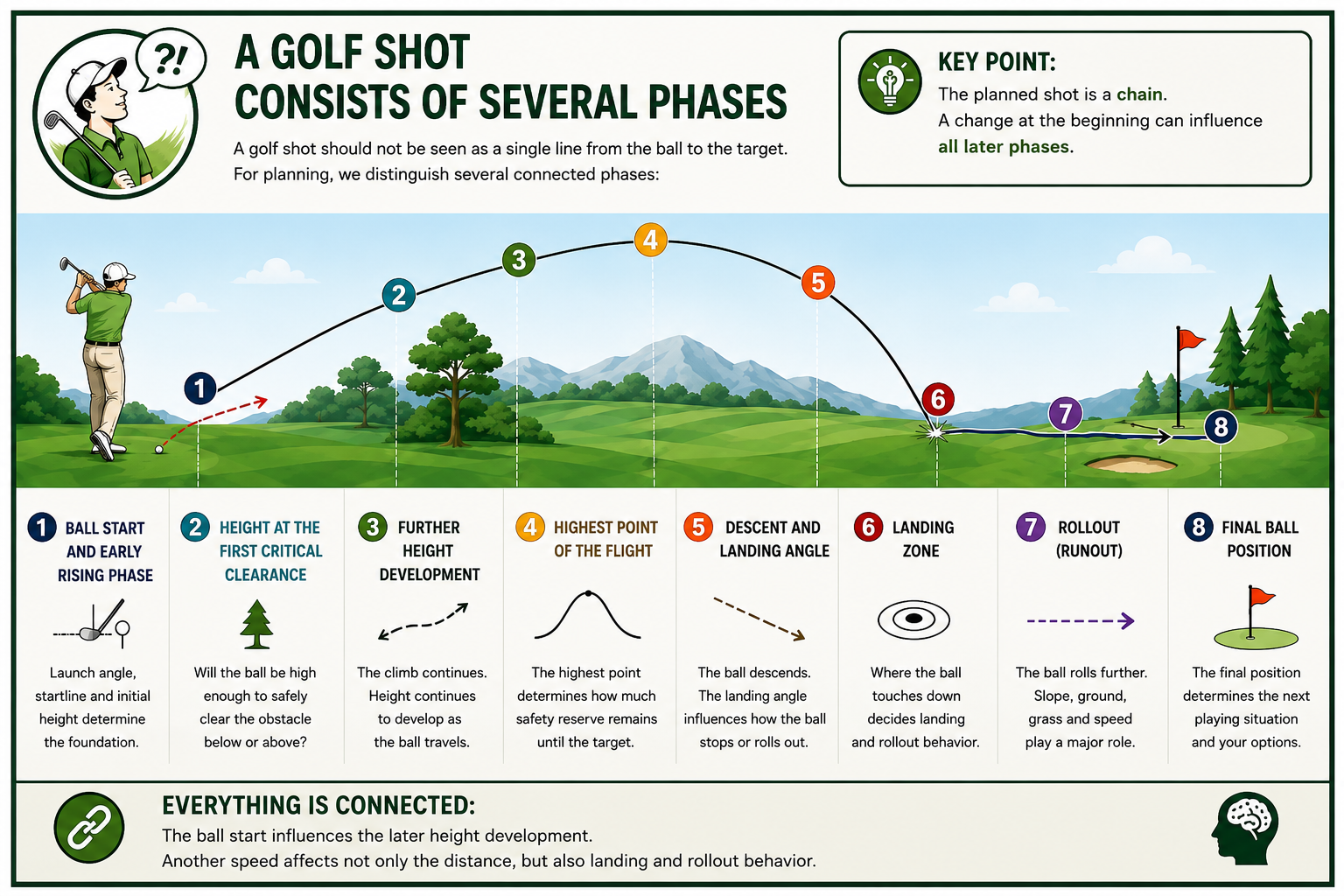
A ball flight should not be viewed as a single line from the ball to the target.
For planning purposes, we distinguish several connected phases:
- ball launch and early rising trajectory,
- height at the first critical boundary,
- the subsequent height profile,
- the highest point of the trajectory,
- descent and landing angle,
- landing zone,
- runout,
- and final ball position.
These phases cannot be separated completely. If the launch changes, the later height profile often changes as well. A different speed affects not only distance, but also landing and runout behaviour.
Key point: The planned shot is a chain. A change at the beginning can influence every later phase.
The first success can be judged too early
A recovery shot flies underneath the branch. The golfer immediately feels relieved because the visible obstacle has been cleared.
But the ball may then:
- continue rising and hit a second branch,
- land too early and stop in the rough,
- land too shallow and roll into a bunker,
- run too far and leave the fairway again,
- or finish behind another tree.
The shot may have cleared the first obstacle, but it has not improved the playing situation enough.
A recovery shot should therefore not be judged at the first tree. What matters is the quality of the new lie and position.
The minimum carry distance needs to be reached first
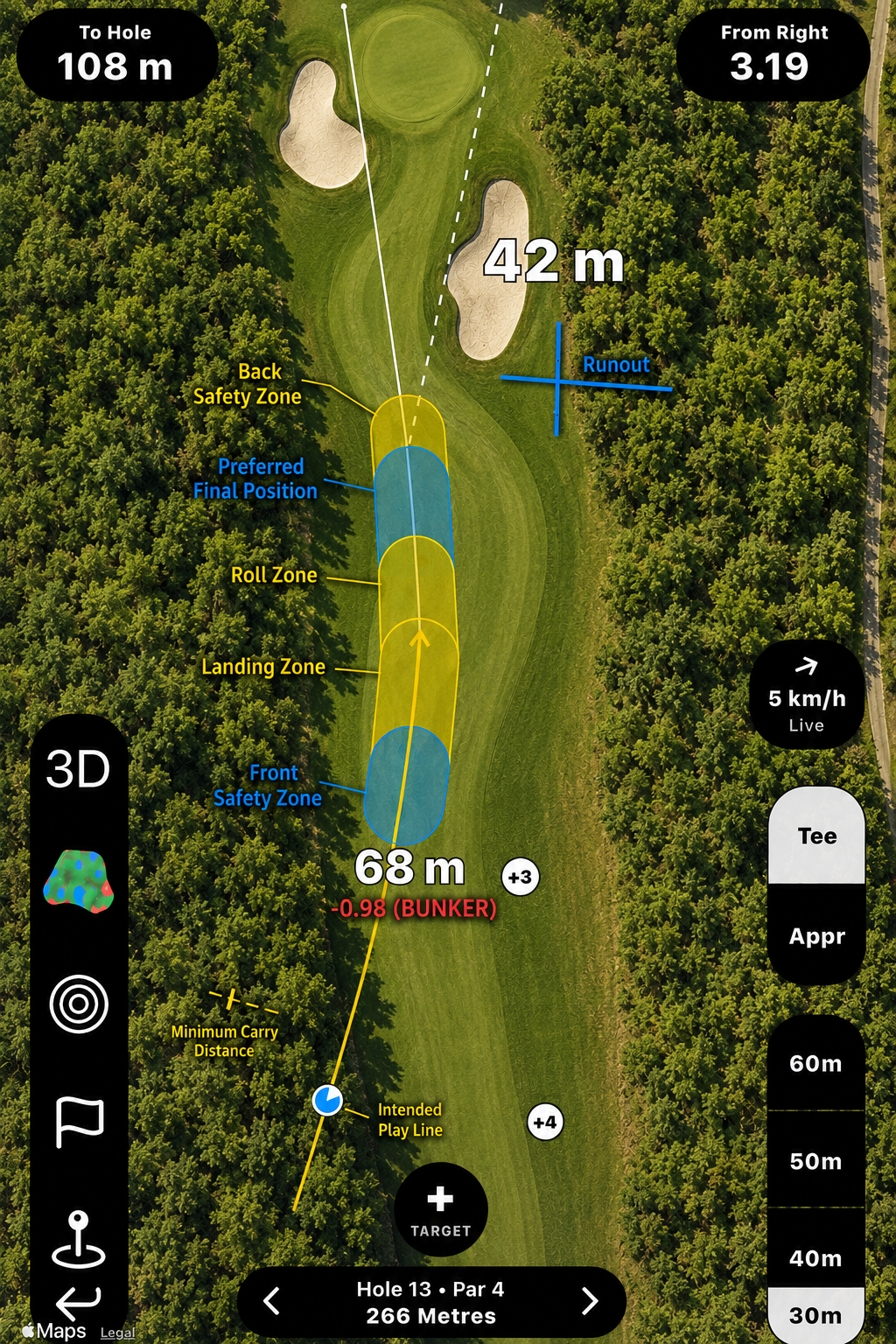
Many difficult shots have a distance that the ball needs to carry safely through the air.
Before the intended landing area there may, for example, be:
- long grass,
- a bank,
- a bunker,
- a rocky area,
- a wall,
- or an area from which the next shot would be difficult to control.
If the ball finishes short of this boundary, it does not reach the intended landing zone. The golfer therefore first needs to establish the minimum carry distance that must be achieved reliably.
This distance should not be achievable only with the best strike. A normal, slightly weaker contact should still clear the critical area whenever possible.
The required minimum carry distance therefore needs to be planned not only around the ideal strike, but with sufficient safety margin and margin for error.
The landing zone is not the finishing position
Golfers often talk about a target point and mean the place where the ball should eventually finish.
For a running recovery shot, however, two areas need to be distinguished:
- the landing zone: the area where the ball should first touch the ground,
- the finishing position: the area where the ball should come to rest after the runout.
Between the landing zone and the finishing position lies the runout. Its length and direction help determine whether the intended next playing situation is actually created. The landing area and finishing area are therefore better understood as zones rather than single exact points. This connects directly with our approach to playing to zones in golf, where the golfer plans enough space for normal variation instead of relying on one perfect target point.
A ball can land in the correct area and still run too far. Equally, a ball can land slightly earlier and still reach a good finishing position because its runout behaviour fits the situation.
The plan therefore always needs to answer:
Where should the ball land, how should it react there and where should it finish afterwards?
Landing angle influences runout
The same landing zone can lead to very different finishing positions.
A higher ball flight can land more steeply and stop more quickly. A lower ball flight can continue much farther after landing.
Runout is additionally influenced by:
- ball speed,
- spin,
- landing angle,
- ground firmness and moisture,
- slope,
- grass length,
- and irregularities in the ground.
A low shot underneath a tree can therefore run much farther than a normal approach shot played with the same club.
If the golfer plans only the carry distance, an important part of the shot is being ignored.
Runout limits the usable shot
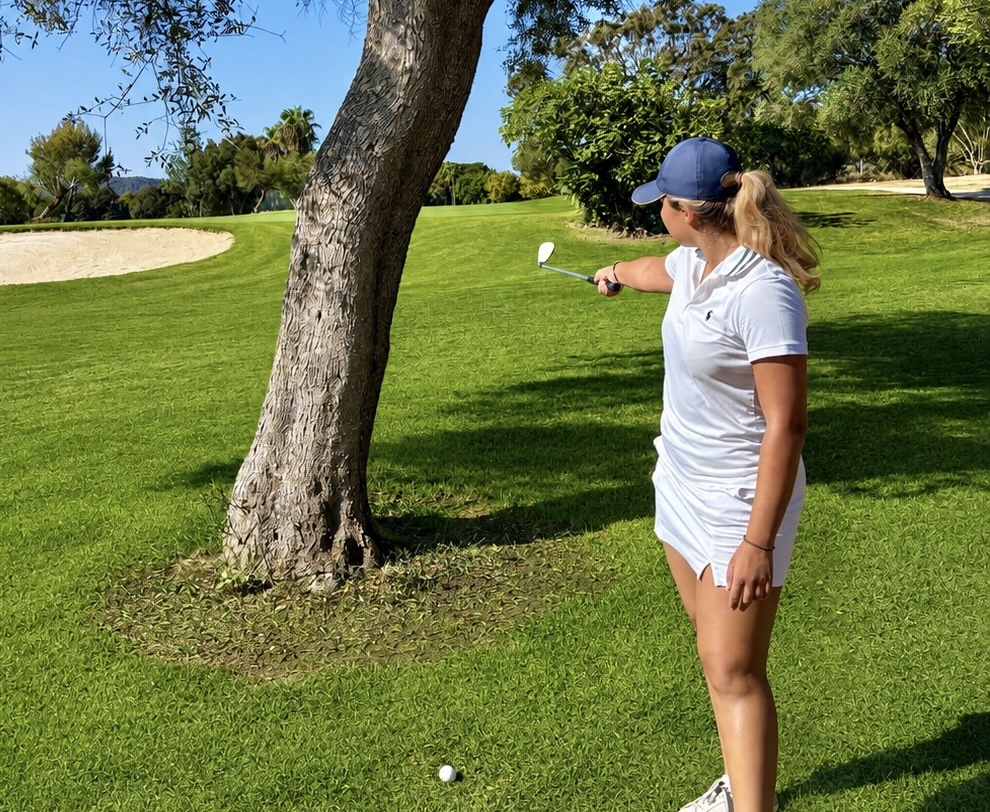
We use the term runout for the boundary of the still usable rollout area. If the ball travels beyond it, it reaches a significantly worse or less controllable position.
A runout boundary can be created by:
- a bunker beyond the intended finishing position,
- rough or bushes,
- out of bounds,
- a path crossing the playing area,
- water,
- or a downhill edge of the terrain.
There needs to be additional safety margin between the intended finishing position and the runout boundary.
The firmer the ground, the shallower the landing and the less predictable the speed, the larger this space should become.
The next shot position is part of the decision
An open area of fairway is not automatically a good finishing position.
The golfer should therefore plan at least one shot ahead:
- Will the next shot have a clear line?
- Is the angle towards the green useful?
- Will the ball finish on a level area?
- Will a tree block the next line?
- Does the shot create a difficult distance?
- Or is there a risk of creating another recovery situation?
The purpose of a recovery shot is not simply to move the ball out of the current position somehow. It should prepare the most playable next situation possible.
This connection between the current lie, possible finishing position and next shot is a central part of our Strategy Lab.
Key point: The best finishing point is not always the farthest point. What matters is where the next shot can be played with control.
More distance does not automatically mean more progress
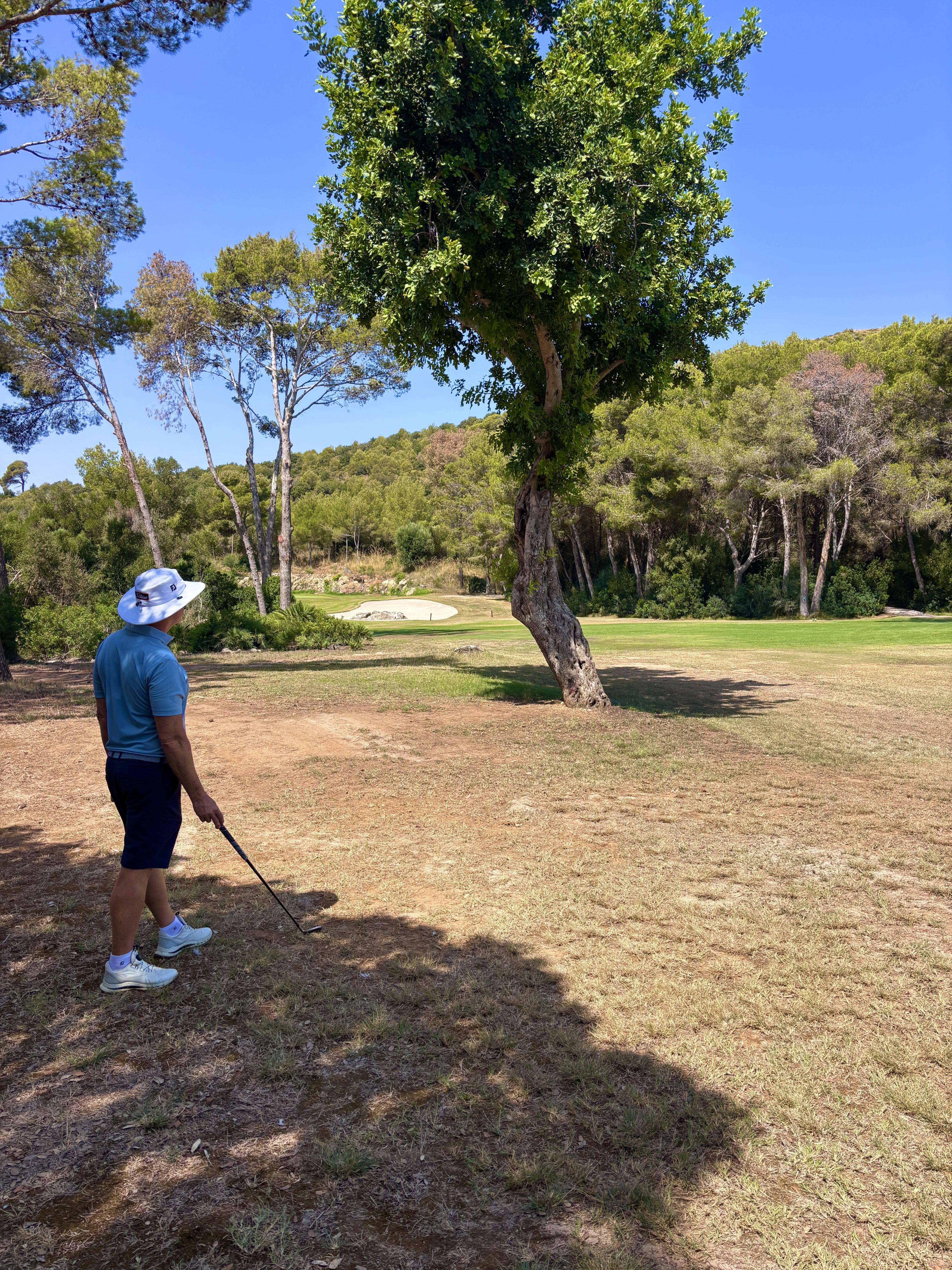
A recovery shot can move the ball a long way forwards and still achieve very little strategically.
A shorter shot can be better if it:
- reaches a wide playing area,
- creates a clear angle towards the green,
- avoids another line of trees,
- moves the ball away from a difficult lie,
- and limits the possible damage caused by a miss.
The quality of the shot is therefore not measured only in metres gained. It also shows in how well the next playing situation has been prepared.
Plan A, Plan B and Plan C
A difficult situation rarely has only one possible solution. It therefore makes sense to recognise simpler alternatives alongside the preferred option.
- Plan A: the preferred playable solution under the current conditions,
- Plan B: a less demanding alternative when lie, form on the day or safety margin speak against Plan A,
- Plan C: a clear recovery option when the possible consequences of the other solutions become too great.
The right solution depends on the lie, the golfer’s personal shot pattern and the possible consequences of a miss. During coaching, the golfer learns to choose the appropriate option.
Plan B and Plan C are not signs of uncertainty. They prevent the golfer from holding on to a solution that is no longer sufficiently playable under the current conditions.
A good decision is created when the golfer adapts the solution to lie, dispersion, form on the day and possible consequences.
How we train the complete shot trajectory
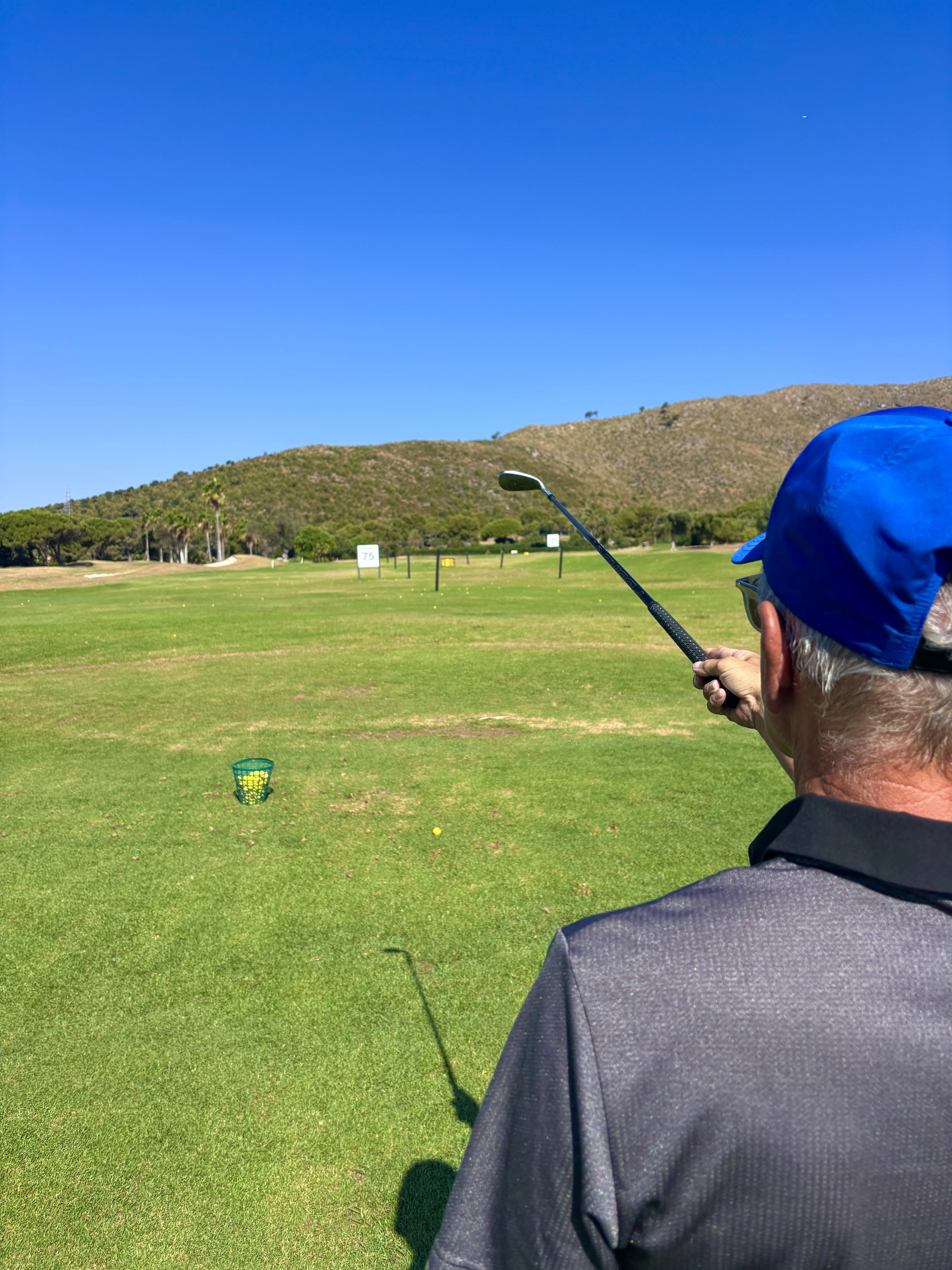
In the Practice Lab and in real on-course situations, a shot is not simply executed technically. The golfer learns to describe it in advance as a complete sequence.
This includes:
- ball launch and height at the critical boundary,
- landing zone and how the ball should react,
- runout and intended finishing position,
- as well as the variations that would still remain playable.
After the shot, the prediction and the actual trajectory are compared. The golfer does not only assess whether the ball was struck well. They also identify which parts of the plan were accurate and where reality differed from the expectation.
We explain how this comparison becomes useful learning information in the chapter Comparing prediction and reality in golf.
Technology can support this comparison when useful, but it does not replace the learning process. Measured data or visual representations can help us identify individual parts of the ball flight more accurately. What remains decisive is that the golfer predicts the complete sequence personally, observes it and transfers the learning to a real playing situation.
The exact application differs for every golfer. Lie, shot pattern, speed, preferred miss side and personal abilities determine which questions are particularly important and how the next task is designed.
This individual connection between observation, decision, execution and adjustment is a central part of our Window Programme.
It also reflects a basic principle of our Golf Learning System: perception, prediction, practical experience and transfer to the golf course are connected.
We develop this process with golfers directly in real playing situations during our golf courses for handicap golfers in Mallorca.
What belongs to complete shot planning
For a playing situation, complete golf shot planning can be summarised in four connected areas:
- the critical distances and heights,
- the intended landing and expected runout behaviour,
- the desired finishing position and possible runout boundaries,
- and the margin for error of the complete solution.
How these pieces of information are weighted, in what order they are processed and how they are adapted to the golfer’s personal shot pattern are part of our Window Programme.
In practice, the golfer develops a decision-making process that can later be transferred to different playing situations.
Planning the complete shot trajectory in golf lessons

The complete shot trajectory is best learned in situations where ball launch, obstacles, landing zone, runout and the next ball position are actually visible and can be assessed. This turns an individual shot idea into a complete plan from launch through to the next playing situation.
If you would like to experience our training concept yourself, we offer suitable programmes for beginners and experienced handicap golfers, as well as golfers who want to develop course strategy and decision-making in greater depth through our Strategy Lab.
You do not only learn to clear the current obstacle. You learn to connect ball launch, height profile, landing, runout and finishing position so that the shot prepares a controllable next playing situation.
[booking]

We do not plan a shot only as far as the first obstacle. We plan ball launch, height profile, landing, runout and the next position as one connected sequence.
The result: the ball does not only overcome the current problem, but prepares a controllable next playing situation.
Professionally developed by Michel Monnard
PGA Golf Professional Michel Monnard has 30 years of experience in golf coaching, course strategy and ball-flight analysis. He teaches at Capdepera Golf in Mallorca and develops the content of the Golf Learning System from real coaching and playing situations.
Basis for this article
This article is based on observations made by Michel Monnard during golf lessons and in real recovery situations at Capdepera Golf. It focuses on minimum carry distance, landing zone, landing angle, runout, finishing position and preparation of the next shot. The complete weighting of these areas, together with the individual Plan A, Plan B and Plan C logic, remains part of personal coaching and the Window Programme.
Contents: Planning the complete golf shot trajectory
This part of the Playable Windows series focuses on how golfers can plan the complete path of a shot from launch and early height development through landing, runout and the final position created for the next shot.
- Playable windows in golf
An overview of how visible space, ball flight, height corridors, safety margins and on-course decisions work together. - Visible window and playable window
Why a visible opening only becomes playable when lie, ball flight, personal ability and possible finishing position are considered. - Launch windows and ball-flight height profile in golf
How launch angle, early height development and distance determine whether a golf ball can travel through a restricted opening. - Why the same golf club can produce different ball-flight heights
How dynamic loft, speed, strike location, spin and lie can change the trajectory produced with the same golf club. - Safety margin and margin for error in golf
Why good golf planning needs to allow for normal shot variation rather than relying only on the perfect strike. - How to read height corridors in golf
How upper and lower boundaries, distance, rising trajectory and apex create the three-dimensional space available for a golf shot. - Planning the entire shot trajectory in golf
How launch, height development, landing zone, runout and final ball position should be planned as one connected sequence rather than as separate parts of a shot. - Comparing prediction and reality in golf
How comparing the expected ball flight with what actually happens improves learning, judgement and future decisions. - Developing personal height control in golf
Why golfers need to understand their own height profiles, normal variation, different club trajectories and the ball flights that are realistically available to them. - Integrating playable windows into decisions on the golf course
How lie, shot pattern, safety margin, consequences and the next playing position determine whether a technically possible shot is also a sensible strategic choice.
For beginner golfers
- How beginners can get back into play from difficult lies
How new golfers can use larger openings, familiar shots and safer target areas to recover from difficult positions and prepare a normal next playing situation.
How the topic connects to our Golf Learning System
- How the Window Programme makes our Golf Learning System visible
How understanding, technical foundations, skill development, Practice Lab, Strategy Lab, technology and on-course transfer combine within one connected learning process.
[booking]
The shot is not judged by whether it clears the first problem, but by the next playing situation it prepares.


