

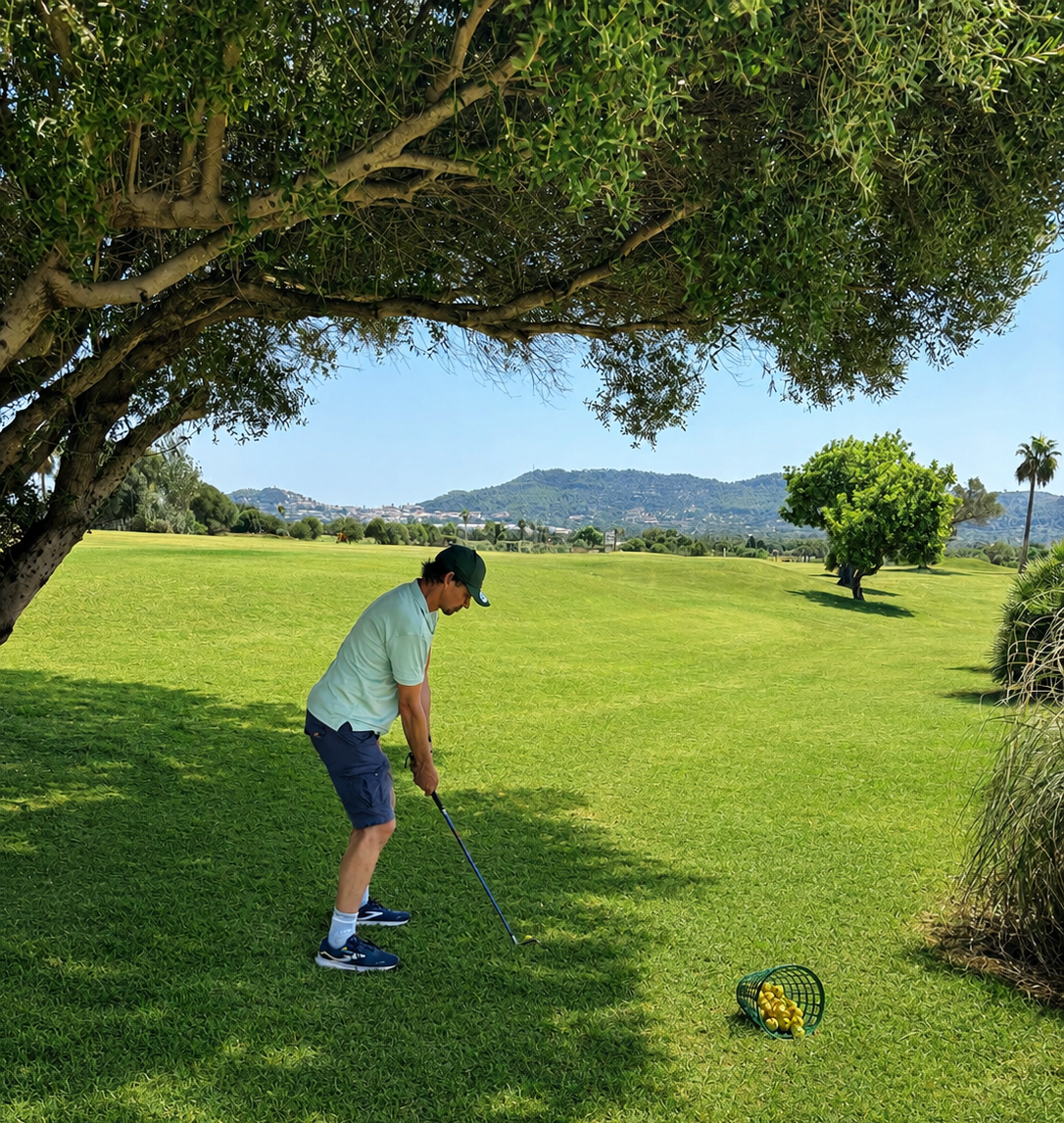
A golfer stands in front of a tree and sees a clear opening underneath the branches. The ball appears to fit through without any problem.
But a height corridor is not limited to the space directly in front of the ball.
After launch, the ball first gains height, reaches its highest point and then begins to descend. A shot can therefore pass underneath the first branch and still hit a tree canopy or a more distant branch only a few metres later.
To read a height corridor correctly, the golfer therefore needs to recognise more than how high an obstacle is. Equally important are:
- how far the obstacle is from the ball,
- how the height of the ball develops before it reaches the obstacle,
- where the highest point of the trajectory occurs,
- where the ball needs to land so that it remains within the available height,
- and how much safety margin remains to the boundary.
The key question is therefore not:
Is there enough room underneath this branch?
But rather:
What height does my ball have at every critical point within this corridor?
A height corridor is a three-dimensional space
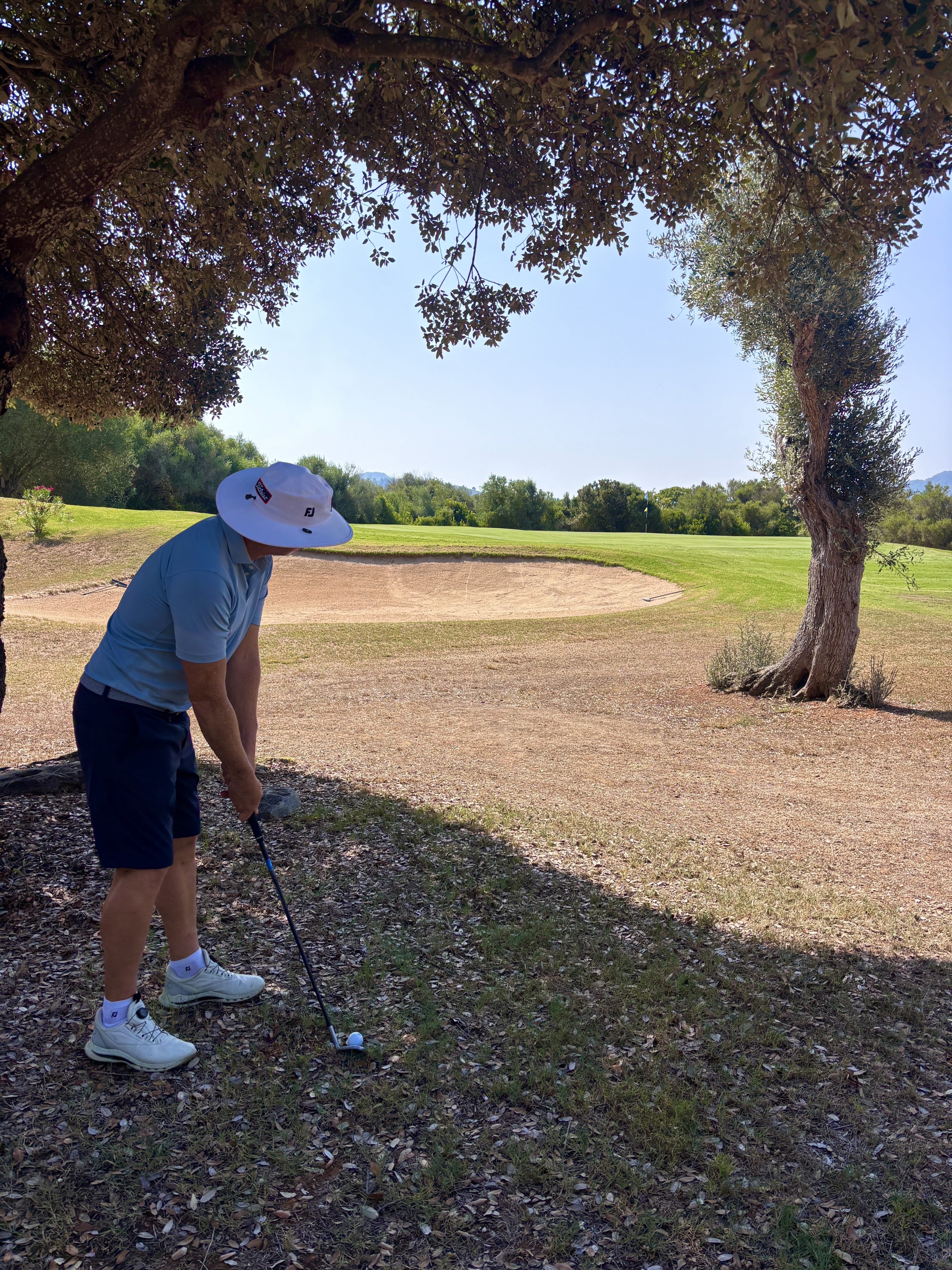
Golfers often look at an opening like a flat picture. They see a tree trunk on the left, a bush on the right and several branches above.
The ball, however, moves through a three-dimensional space.
This space has:
- a lateral width,
- a lower boundary,
- an upper boundary,
- a certain length,
- and a target or finishing zone.
A height corridor is therefore not a single hole between branches. It describes the spatial area within which the ball needs to travel during the part of the flight that is critical for the playing situation.
Key point: A clear opening at the beginning of the trajectory does not automatically mean that the entire height corridor is clear.
The distance to the obstacle changes the task
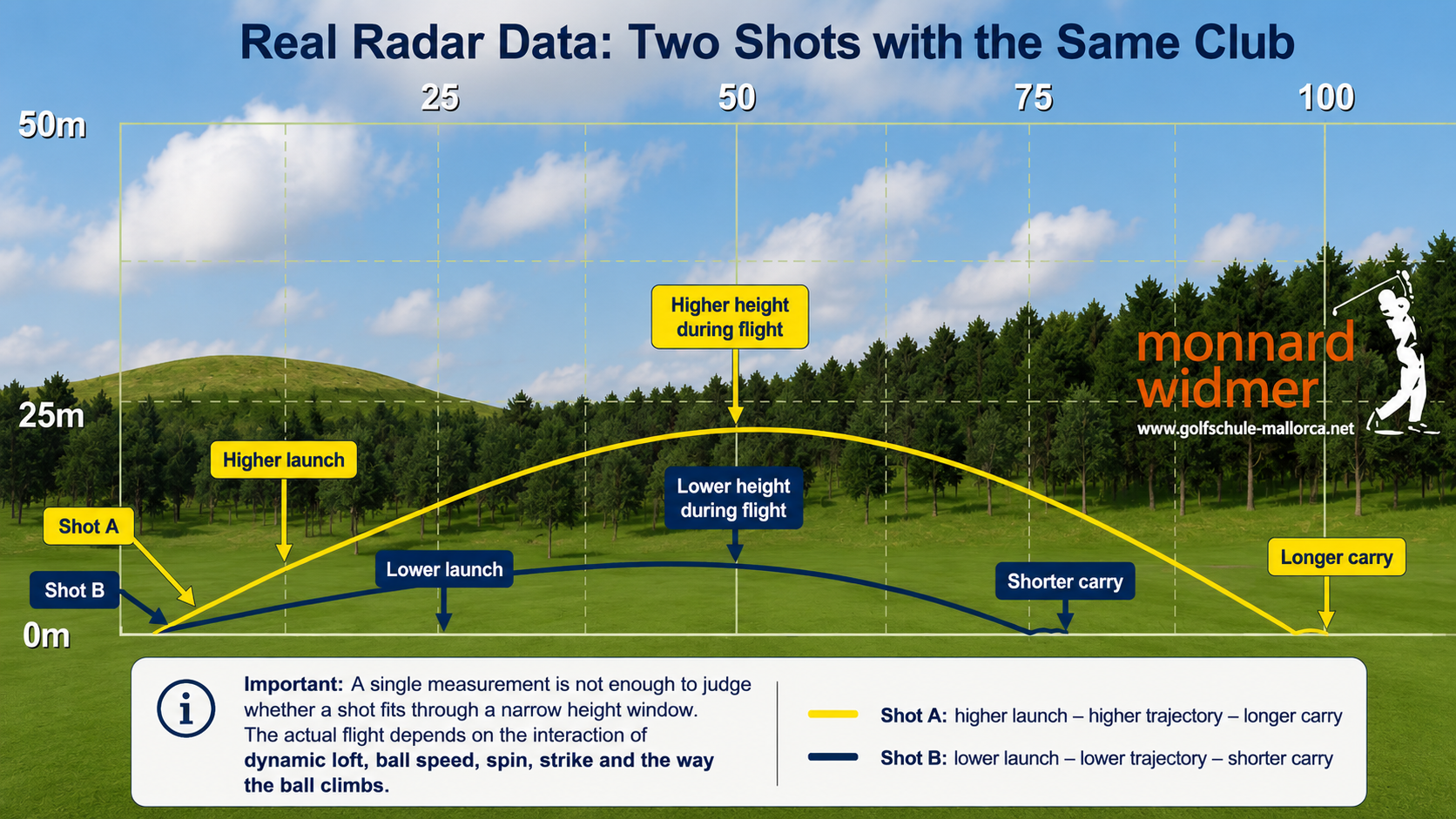
A branch two metres above the ground directly in front of the ball creates a different task from a branch of the same height 25 metres away.
If the obstacle is very close, the ball needs to remain below the boundary immediately after impact. Launch angle and the early rising trajectory become decisive.
If the same boundary is farther away, the ball may start low and still have gained considerable height by the time it reaches the obstacle.
The golfer should therefore always connect two pieces of information:
- the height of the boundary,
- and the distance from the ball to that boundary.
Connecting obstacle height with distance is also part of golf shot planning: the golfer needs to define what ball flight the situation requires before choosing the club or shot.
Only this combination provides useful information about whether the intended ball flight actually fits through the corridor.
How height, distance and personal ball-flight variation should be weighted in a specific situation depends on the golfer and the lie. In practice, the golfer learns to connect these pieces of information systematically and use them to define an appropriate ball-flight requirement.
After several repetitions, the golfer begins to assess similar situations more reliably and becomes better at recognising which ball flight genuinely fits through the available window.
At the same time, each attempt helps improve the ability to produce the intended ball flight, observe the outcome and adapt the next decision.
We explain how launch angle, early height development and critical distance work together in the chapter Launch windows and ball-flight height profile in golf.
The first boundary is not always the most critical one
The most obvious obstacle often receives all the attention. A large branch directly in front of the golfer can look particularly threatening.
But the ball may pass this first boundary comfortably and become too high later at a less obvious point.
Critical boundaries can include:
- a second branch beyond the first opening,
- a rising tree canopy farther ahead,
- a higher ridge or change in ground level,
- or a tree beyond the intended landing area.
The critical boundary is the point where the golfer’s normal ball flight has the smallest safety margin to the obstacle.
Why this clearance needs to be planned around the normal variation rather than the perfect shot is explained in more detail in Safety margin and margin for error in golf.
Lower boundaries are often underestimated
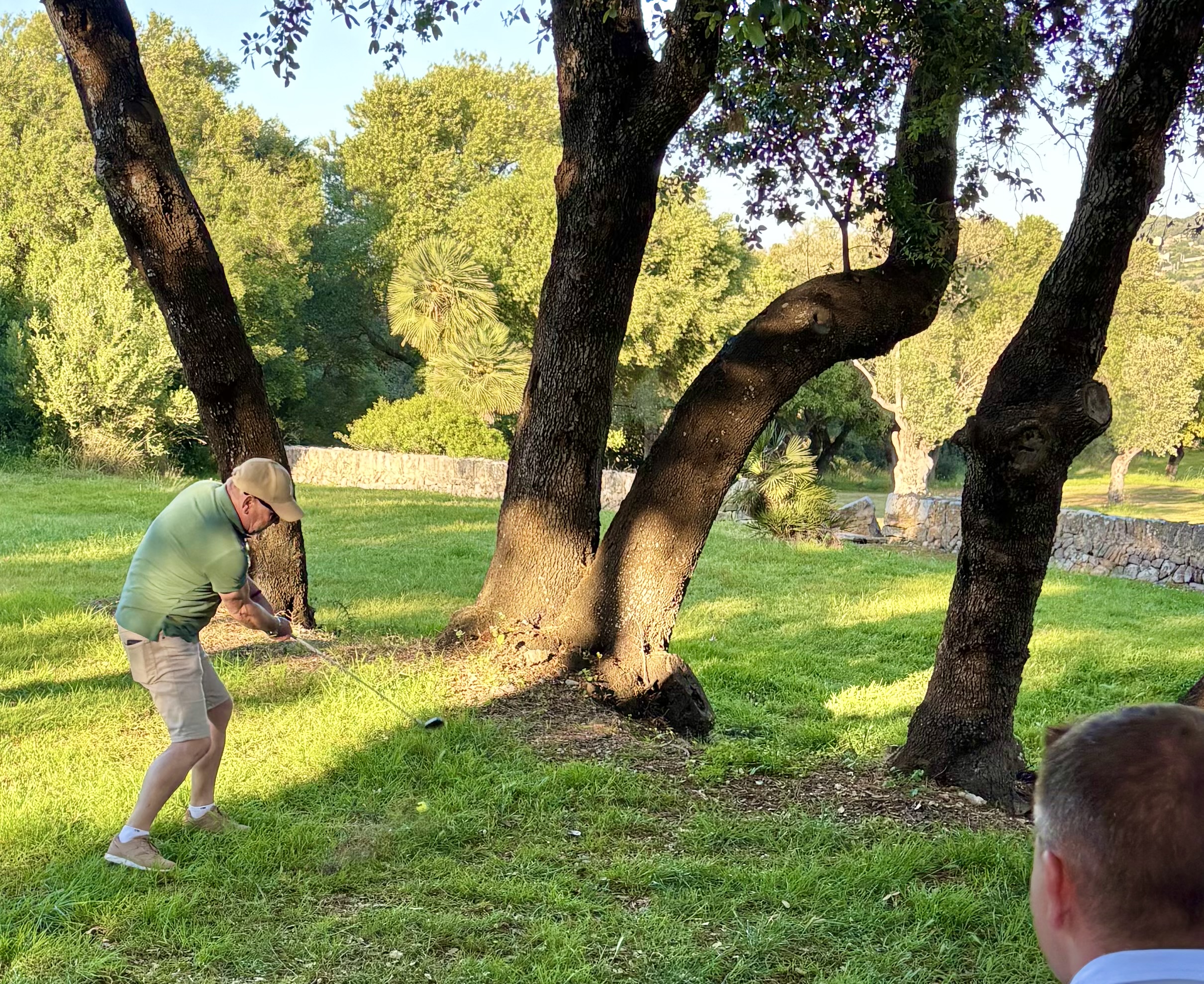
When golfers think about height corridors, they usually look first at branches above the ball.
But a ball can also start too low.
Lower boundaries can include:
- long grass directly in front of the ball,
- a bush or hedge,
- a wall,
- an uphill bank,
- or the ground itself on a very low recovery shot.
A narrow height corridor can therefore have both an upper and a lower boundary. The ball must not start too high or too low.
The narrower this vertical space becomes, the smaller the margin for error.
The highest point of the trajectory needs to fit the situation
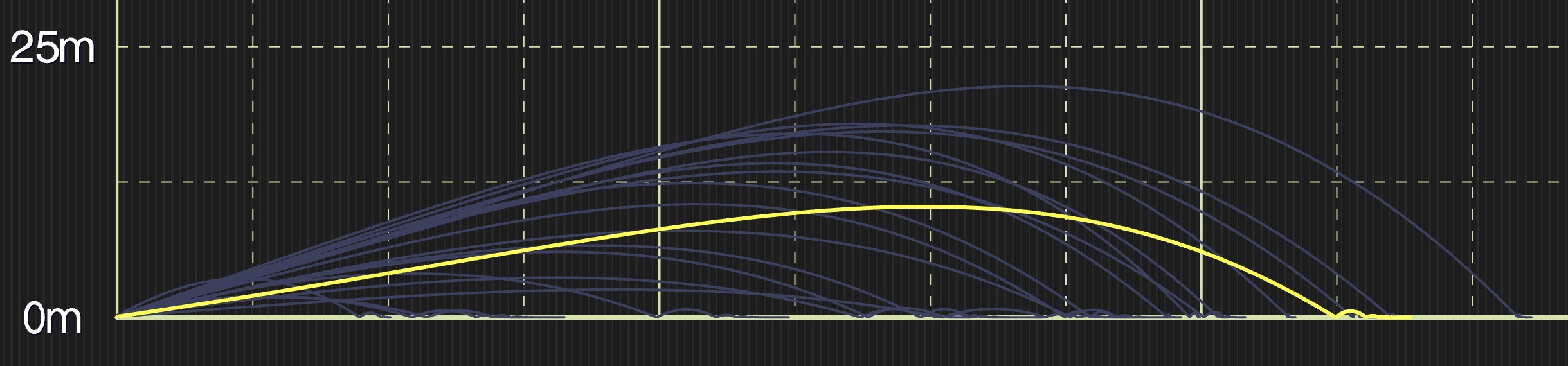
The highest point of a ball flight does not occur at the same point for every club or every shot.
Depending on club, speed, launch angle, spin and strike location, the apex can occur earlier or later within the trajectory. Two shots can reach a similar maximum height and still reach that height at different distances.
For decision-making, it is therefore not enough to know how high the ball flies overall. Where the highest point occurs also matters.
If the maximum height occurs before the critical boundary, the ball may already be descending when it reaches the obstacle. If the apex lies beyond it, the ball may still be rising at the boundary.
This information is particularly important for:
- long recovery shots,
- shots underneath tree canopies,
- height restrictions later in the flight,
- and shots that are only allowed to rise after passing an obstacle.
Perspective can make a height corridor look larger
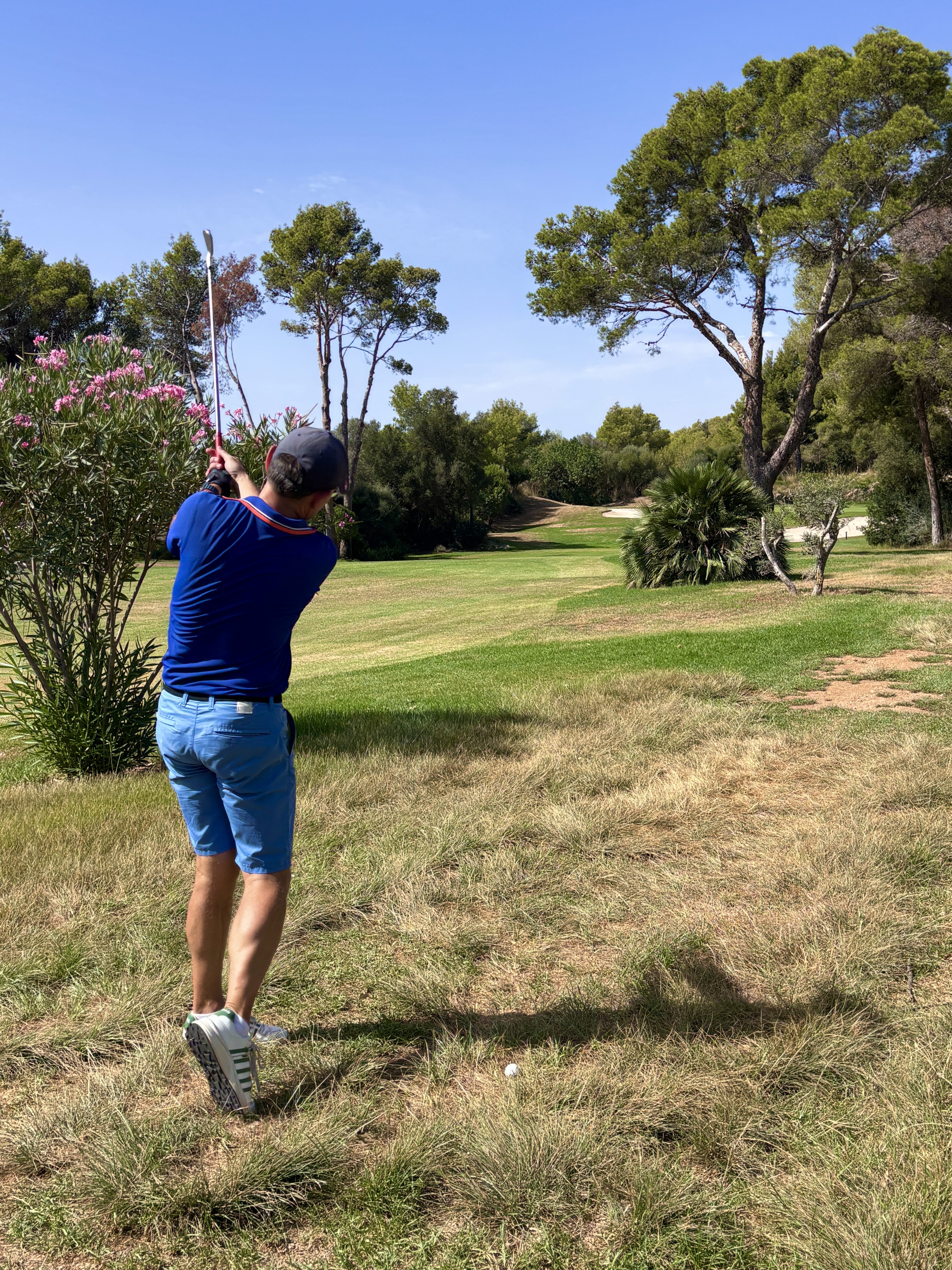
From the ball, a corridor can look generous. The sky behind the branches creates a clearly visible opening.
But this perspective can be misleading.
A more distant branch appears smaller even though it may lie directly in the later trajectory. Likewise, an uphill ridge can look lower from the golfer’s position than it really is.
It can therefore help to assess the situation from several perspectives:
- directly behind the ball,
- a few steps to the side,
- during practice, and when safe to do so, from closer to the critical boundary,
- and with the intended finishing position in view.
There is not always much time for this on the golf course. In practice, however, the golfer can learn which perspective effects most often lead to incorrect judgements.
Width and height need to be assessed together
A height corridor can look vertically sufficient while still being too narrow laterally.
Conversely, there may be plenty of room between two tree trunks while the branches above allow only a very low ball flight.
The golfer therefore needs to assess at the same time:
- How much room is available to the left?
- How much room is available to the right?
- What height may the ball have at the first boundary?
- What height may it have at a later boundary?
- And how much normal variation does the corridor need to accommodate?
A solution is only playable when both directional and height variation have enough room.
This shows again why a visually clear opening is not necessarily a genuinely usable solution. We explain the basic difference in Visible window and playable window.
Height reference lines help with orientation
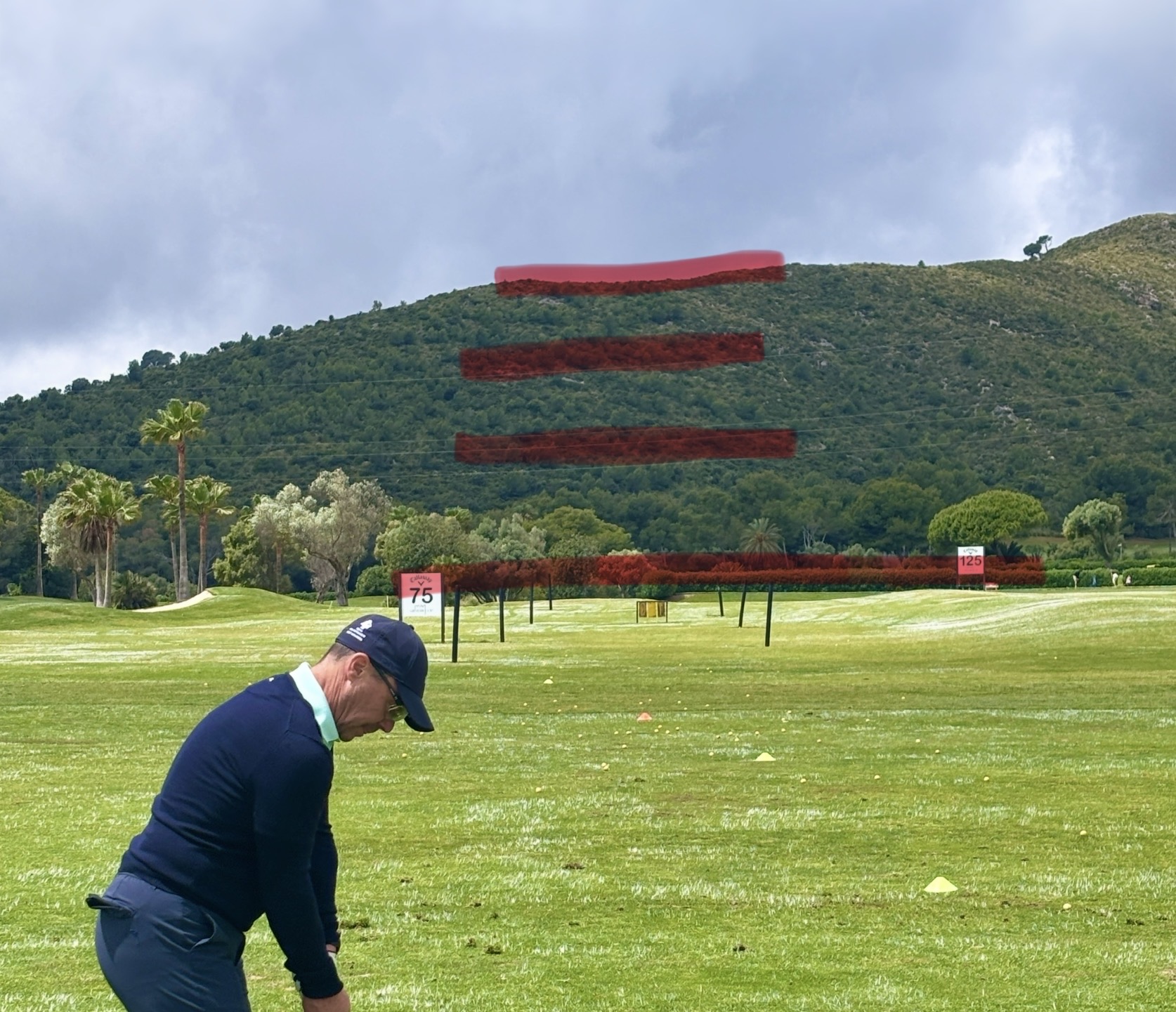
It is difficult to estimate height in metres on the golf course. Visible reference lines therefore help.
These references can include:
- the underside of a branch,
- a tree canopy,
- a mountain ridge,
- power lines,
- distance posts,
- or the horizon behind the ball flight.
On the driving range at Capdepera Golf, for example, we use distance posts, the mountain ridge and power lines as a visible height grid.
The golfer can observe what height the ball reaches at a particular distance and later transfer that perception to real playing situations.
How we train height corridors in the Practice Lab
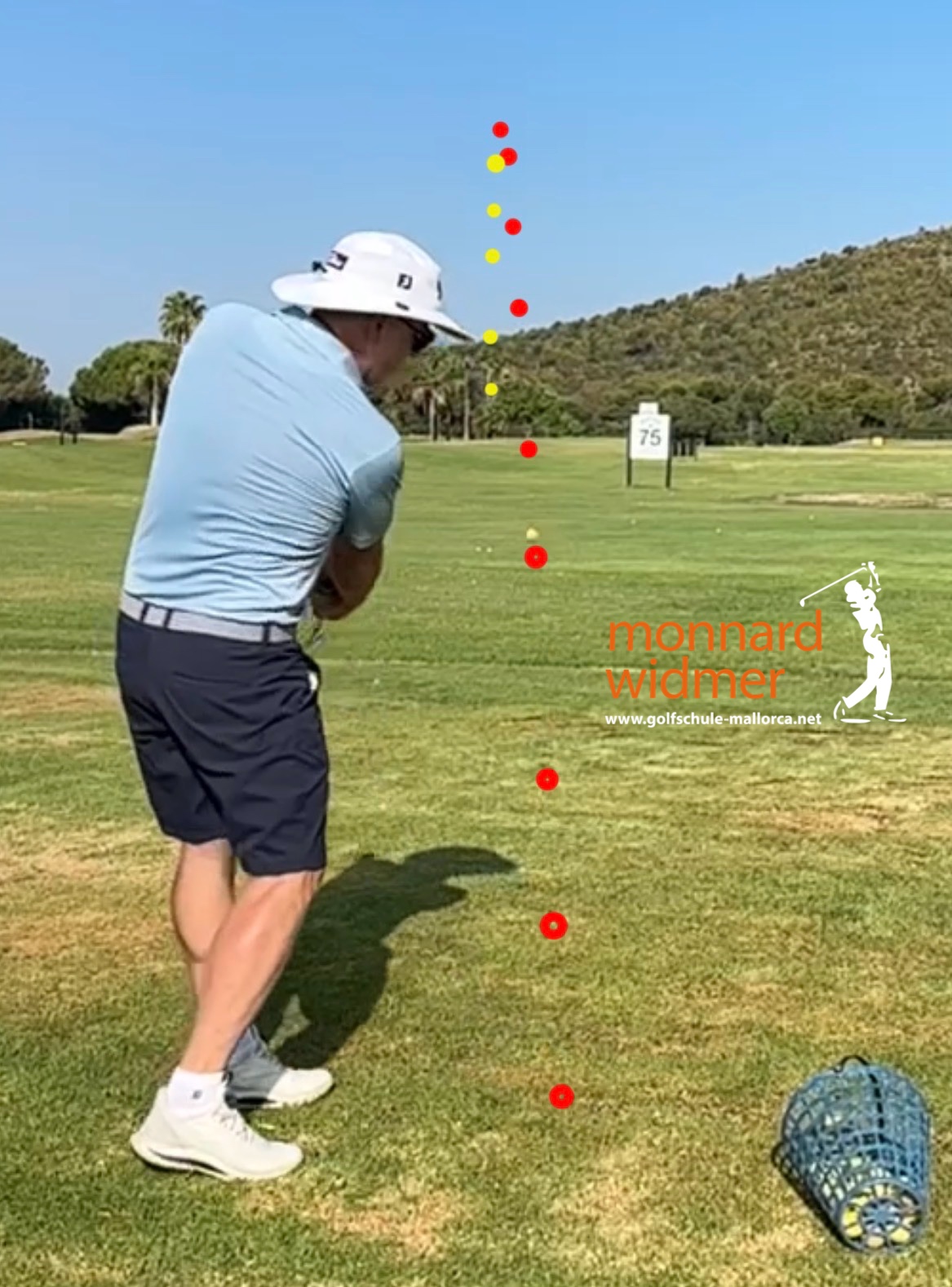
In the Practice Lab, a height corridor is not only explained theoretically. The golfer needs to predict it, execute the shot and then evaluate the result.
A typical learning process can look like this:
- An upper and lower height boundary are defined.
- The distance to the critical boundary is established.
- The golfer predicts what height the ball will have there.
- The golfer chooses club, ball position and shot intention.
- Several shots are played.
- Launch angle, height profile and dispersion are observed.
- Where useful, the results are checked with our portable FlightScope Mevo+ radar.
- The golfer adjusts the next prediction.
This helps the golfer learn more than how to play one low or high shot. They develop an understanding of what height the ball has at different points within the corridor.
This connection between prediction, practical execution, observation and adjustment is part of our Golf Learning System.
Technology is one of our tools, not the teaching method itself. FlightScope can make differences in launch angle and height profile visible. What remains decisive is that the golfer perceives the corridor personally, makes a prediction and then transfers the learning to real playing situations.
A height corridor does not end at the obstacle
A ball can pass successfully underneath a branch and still finish in a poor position.
The golfer therefore needs to think beyond the corridor:
- Where does the ball land?
- How shallow or steep is the landing?
- What runout develops after landing?
- Which obstacles lie beyond the opening?
- And what next position does the shot create?
A playable height corridor therefore connects ball launch, the entire height profile and the eventual finishing position. We explain how landing, runout and the next ball position should be included in planning in the chapter Planning the entire shot trajectory in golf.
Key point: The success of a recovery shot is not measured by whether the ball gets past the first branch. What matters is whether the complete trajectory leads to a playable next position.
Which questions help when reading a height corridor?
- Where does the first upper or lower boundary begin?
- How far is it from the ball?
- Is there a second critical boundary beyond it?
- What height does my normal ball flight have at those distances?
- Where is the highest point of my trajectory?
- How much do launch angle and speed vary?
- How much vertical and lateral safety margin remains?
- Where does the ball land and finish after the corridor?
If the golfer cannot answer these questions well enough, a simpler line with a larger corridor is often the better decision.
Reading and training height corridors in golf lessons

Height corridors are best understood when the golfer directly compares visible boundaries, critical distances and their own ball flight. On the driving range and in real playing situations, it becomes clear whether the ball only fits through the first opening or remains inside the available space throughout the relevant part of the trajectory.
If you would like to experience our training concept yourself, we offer suitable programmes for beginners and experienced handicap golfers, as well as golfers who want to develop course strategy and decision-making more deeply through our Strategy Lab.
You do not only learn to recognise an opening. You learn to compare the entire three-dimensional space with your personal ball flight and assess what height the ball actually needs to have at the critical points.
[booking]

We do not assess a height corridor only where the ball starts. We assess what height it will have at every critical distance.
The result: the golfer no longer sees only the visible opening, but plans the entire three-dimensional ball flight.
Professionally developed by Michel Monnard
PGA Golf Professional Michel Monnard has 30 years of experience in golf coaching, course strategy and ball-flight analysis. He teaches at Capdepera Golf in Mallorca and develops the content of the Golf Learning System from real coaching and playing situations.
Basis for this article
This article is based on observations made by Michel Monnard during golf lessons, height-control tasks in the Practice Lab and real recovery situations at Capdepera Golf. It focuses on upper and lower boundaries, critical distances, the highest point of the trajectory, spatial perception and the required safety margin. The complete training, assessment and decision-making structure remains part of personal coaching and the Window Programme.
Contents: Reading height corridors and ball-flight space
This part of the Playable Windows series focuses on how golfers can read the three-dimensional space available for a shot by combining obstacle height, distance, rising trajectory, apex position and the safety margin required to make a height corridor realistically playable.
- Playable windows in golf
An overview of how visible space, ball flight, height corridors, safety margins and on-course decisions work together. - Visible window and playable window
Why a visible opening only becomes playable when lie, ball flight, personal ability and possible finishing position are considered. - Launch windows and ball-flight height profile in golf
How launch angle, early height development and distance determine whether a golf ball can travel through a restricted opening. - Why the same golf club can produce different ball-flight heights
How dynamic loft, speed, strike location, spin and lie can change the trajectory produced with the same golf club. - Safety margin and margin for error in golf
Why good golf planning needs to allow for normal shot variation rather than relying only on the perfect strike. - How to read height corridors in golf
How obstacle height, distance, rising trajectory, apex position and upper and lower boundaries define the three-dimensional space a ball flight must fit through. - Planning the entire shot trajectory in golf
Why shot planning should include launch, height profile, landing, runout and the position prepared for the next shot. - Comparing prediction and reality in golf
How comparing the expected ball flight with what actually happens improves learning, judgement and future decisions. - Developing personal height control in golf
Why golfers need to understand their own height profiles, normal variation, different club trajectories and the ball flights that are realistically available to them. - Integrating playable windows into decisions on the golf course
How lie, shot pattern, safety margin, consequences and the next playing position determine whether a technically possible shot is also a sensible strategic choice.
For beginner golfers
- How beginners can get back into play from difficult lies
How new golfers can use larger openings, familiar shots and safer target areas to recover from difficult positions and prepare a normal next playing situation.
How the topic connects to our Golf Learning System
- How the Window Programme makes our Golf Learning System visible
How understanding, technical foundations, skill development, Practice Lab, Strategy Lab, technology and on-course transfer combine within one connected learning process.
[booking]


