

Golfers associate each club with a certain ball flight. A pitching wedge flies high, a 7-iron at a medium height and a hybrid comparatively low.
This association is useful as a general reference. However, it can create the impression that a club always produces the same flight height.
In reality, the same golfer can produce clearly different ball flights with the same club. The ball can start lower or higher, rise earlier or later, reach a different maximum height and react differently after landing.
For a playable window, this variation is important. The question is therefore not only:
Which club am I playing?
But rather:
What ball flight do I produce with this club from this lie and with my normal strike pattern?
This is one of the reasons golfers see the tree and still hit it: they recognise the obstacle, but plan with a ball flight they cannot reliably produce with that club.
We explain how launch angle, early height development and height at a critical distance work together in the chapter Launch windows and ball-flight height profile in golf.
Static loft remains the same
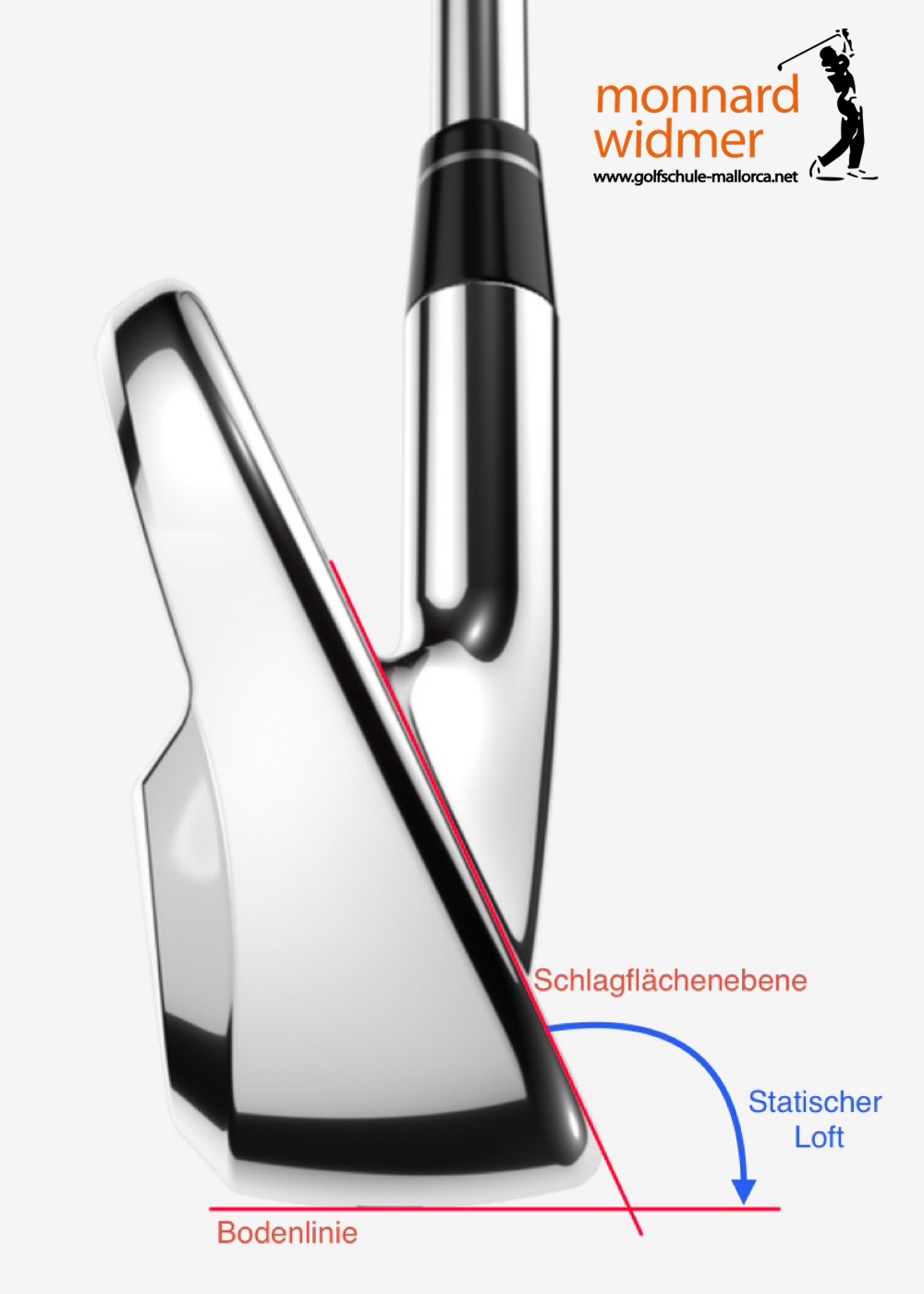
Static loft is the designed angle of the clubface when the club is held in a defined position. It belongs to the club and does not change as long as the same club is being used.
A 7-iron therefore has a different static loft from a pitching wedge or hybrid. These differences influence the general way in which a club can launch the ball.
Static loft, however, does not fully describe how much loft the clubface actually presents to the ball at impact.
Key point: Static loft belongs to the club. The actual ball flight is created at impact.
Dynamic loft is created at impact
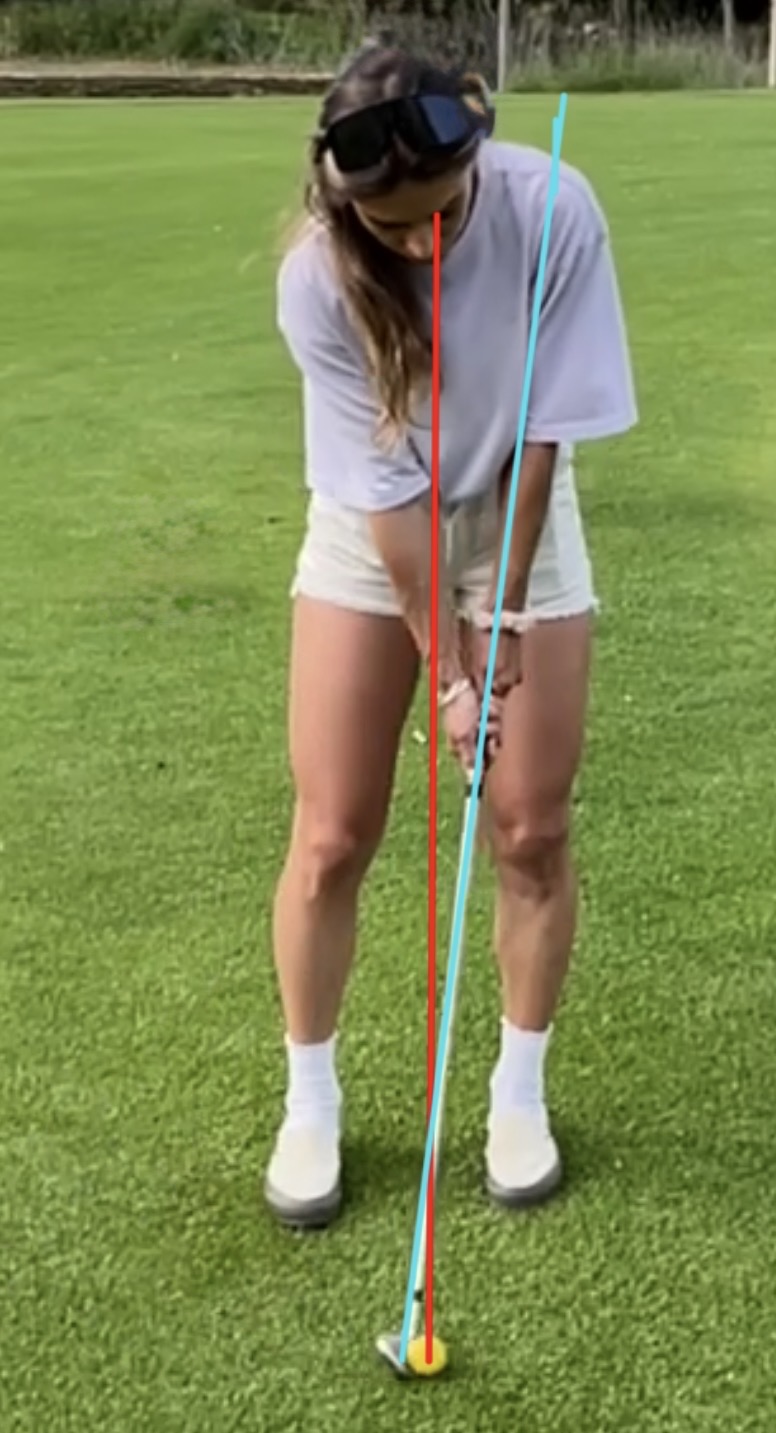
Dynamic loft is the angle the clubface actually presents to the ball at impact. In the image, the blue line shows the shaft position. This is one visible influence, but it does not describe dynamic loft on its own. What matters is the actual orientation of the clubface at impact.
Dynamic loft can differ from static loft. The golfer can present the club with less or more loft at impact.
Dynamic loft is influenced, among other things, by:
- shaft position at impact,
- hand position,
- ball position,
- the movement of the clubhead,
- clubface orientation,
- and the conditions of the actual ball contact.
The same club can therefore reach the ball with less dynamic loft on one shot and more on another. At the same time, strike location, ball speed, spin and start line may also change.
This changes the ball launch and can influence the entire height profile that follows.
A higher launch does not explain the entire ball flight
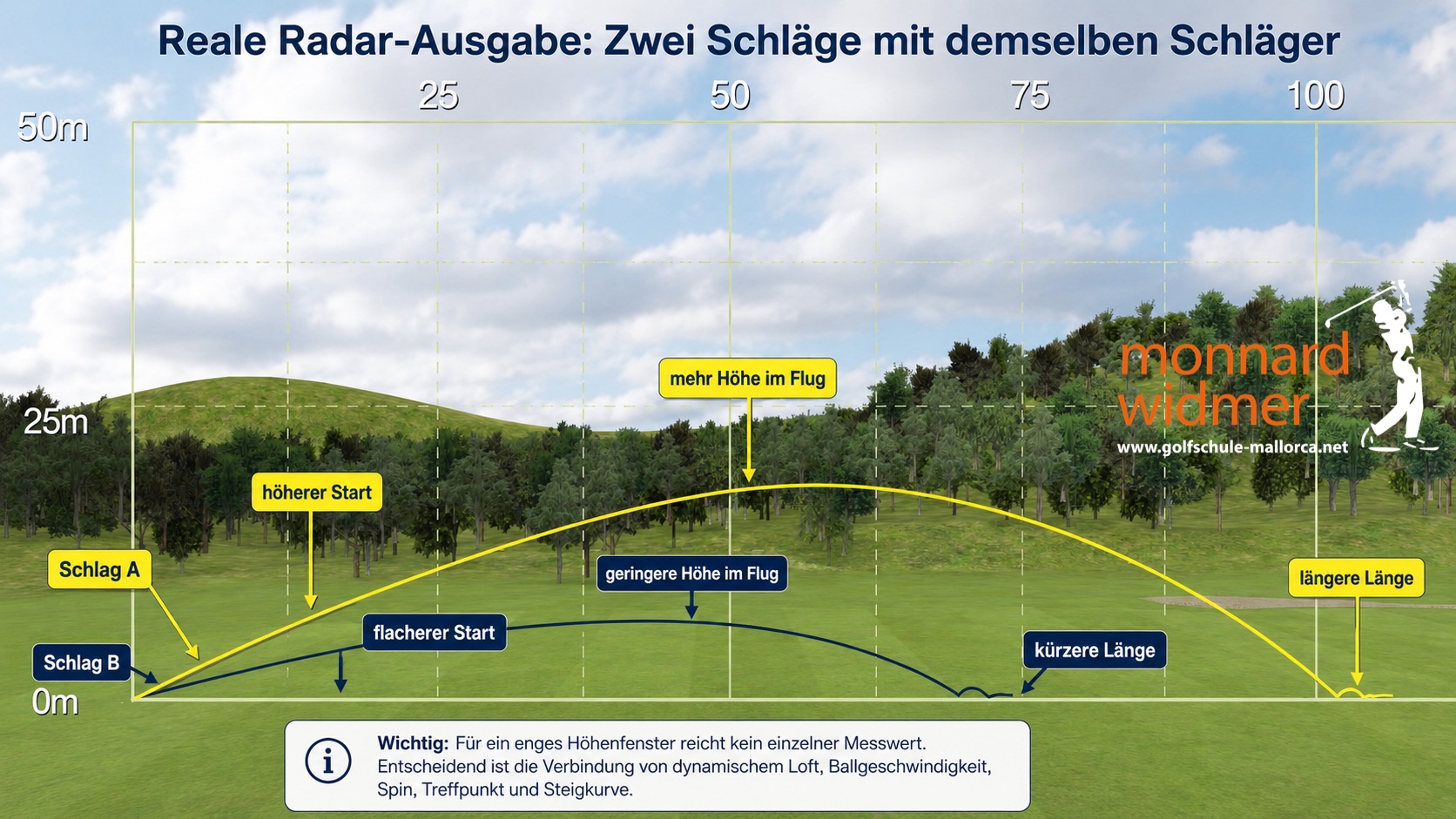
More dynamic loft can cause the ball to launch higher. But other factors are important for the later trajectory.
A higher launch can, for example, occur together with lower ball speed. The ball then starts higher but may not have enough speed to continue gaining height over a longer distance.
Another shot may start lower while also producing more ball speed. It can therefore remain lower initially and still gain more height farther along the flight.
The actual ball flight therefore results from the interaction between:
- dynamic loft,
- launch angle,
- ball speed,
- spin,
- strike location,
- and the subsequent rising trajectory.
For a narrow height window, no single measurement should therefore be considered in isolation.
These relationships are not a fixed rule for every shot. If speed, strike location, spin and clubface orientation all change at the same time, a faster shot can also launch higher and fly considerably higher overall.
Strike location changes speed and ball launch
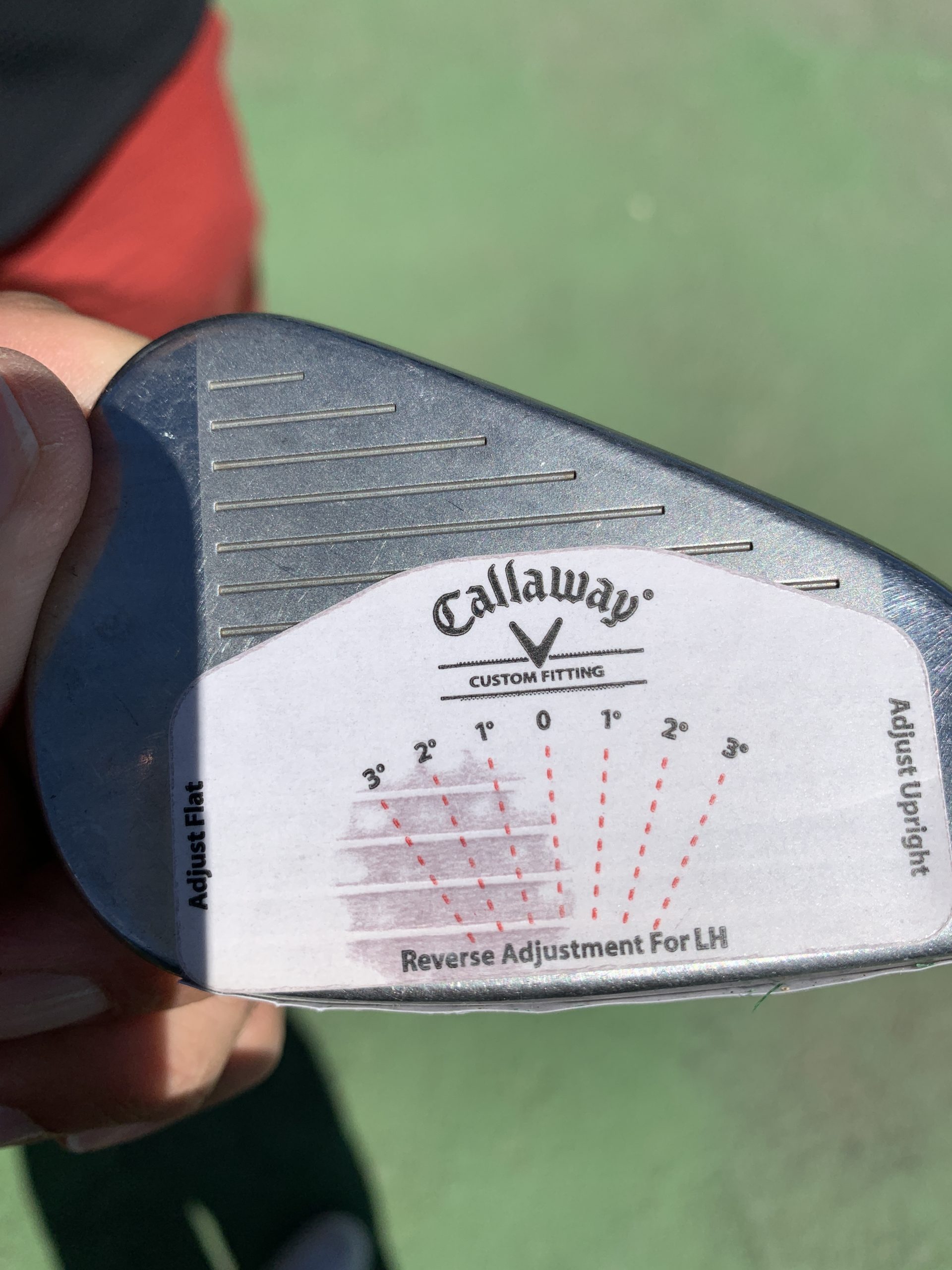
Ball flight does not only depend on the angle at which the clubface arrives. Where the ball is struck on the clubface is equally important.
A centred strike generally transfers energy differently from contact lower or higher on the face, towards the toe or towards the heel. As a result, ball speed, launch, spin and direction can change.
A change in strike location can influence:
- ball speed,
- launch angle,
- spin rate,
- start line,
- and therefore the height at a critical distance.
A shot can therefore start too high, too low, too short or laterally outside the planned window even when the club selection itself was appropriate.
Key point: The club can be correctly selected while the ball flight it produces still does not fit the situation.
Ball position changes the loft presented at impact

The position of the ball in the stance can also change how the club reaches the ball.
For some golfers, moving the ball farther back can lead to more forward shaft lean and less dynamic loft at impact. Moving the ball farther forward can create contact at a different point in the movement and therefore change the loft presented to the ball.
These adjustments, however, do not guarantee a particular ball flight. When the golfer changes ball position, several other factors often change at the same time:
- strike location,
- clubface orientation,
- the direction of the clubhead movement,
- ground contact,
- and speed.
A theoretically sensible adjustment may therefore improve the intended ball flight while simultaneously reducing strike quality.
The lie changes reliability

From a clean fairway lie, contact can usually be planned more reliably than from rough, semi-rough, a sloping lie or uneven ground.
Grass between clubface and ball can change speed, spin and ball launch. In rough, the clubhead can twist or slow down before impact. On hard or dry ground, ground contact becomes particularly important.
This does not only make execution more difficult. It also makes the actual ball flight harder to predict.
The visible window itself may remain unchanged. From a more difficult lie, however, the area the golfer can use reliably becomes smaller. This is exactly the difference between a visible opening and a genuinely playable one. We explain this relationship in detail in Visible window and playable window.
In real playing situations, the golfer therefore needs to assess whether the current lie allows the required strike and planned dynamic loft to be produced reliably enough.
Speed also varies with the same club
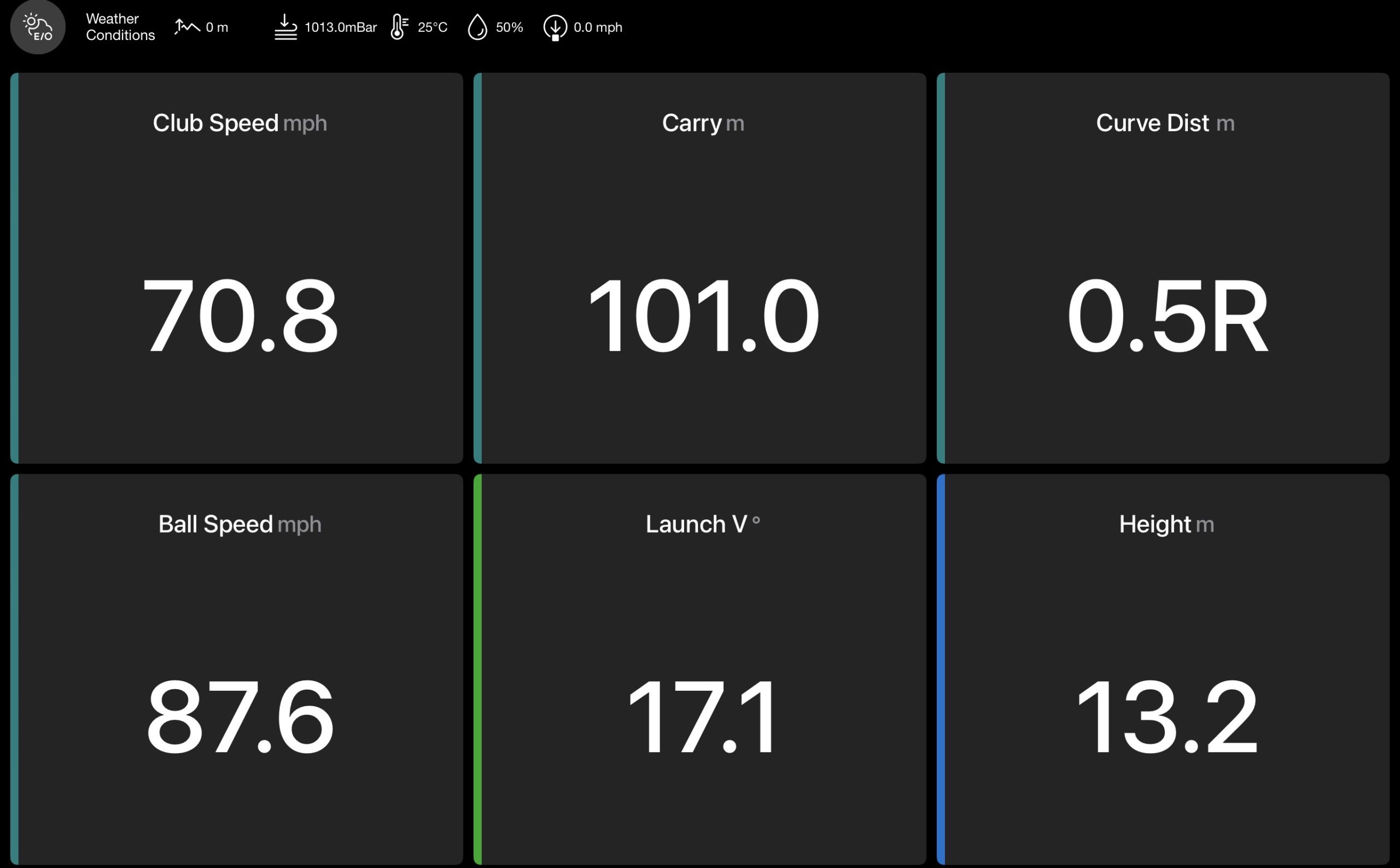
Even when the golfer uses the same club and the same general shot intention, club speed and ball speed are not identical on every attempt.
Speed can change because of:
- different swing length,
- deliberately reduced pace,
- uncertainty in a narrow situation,
- changes in balance,
- or poorer strike quality.
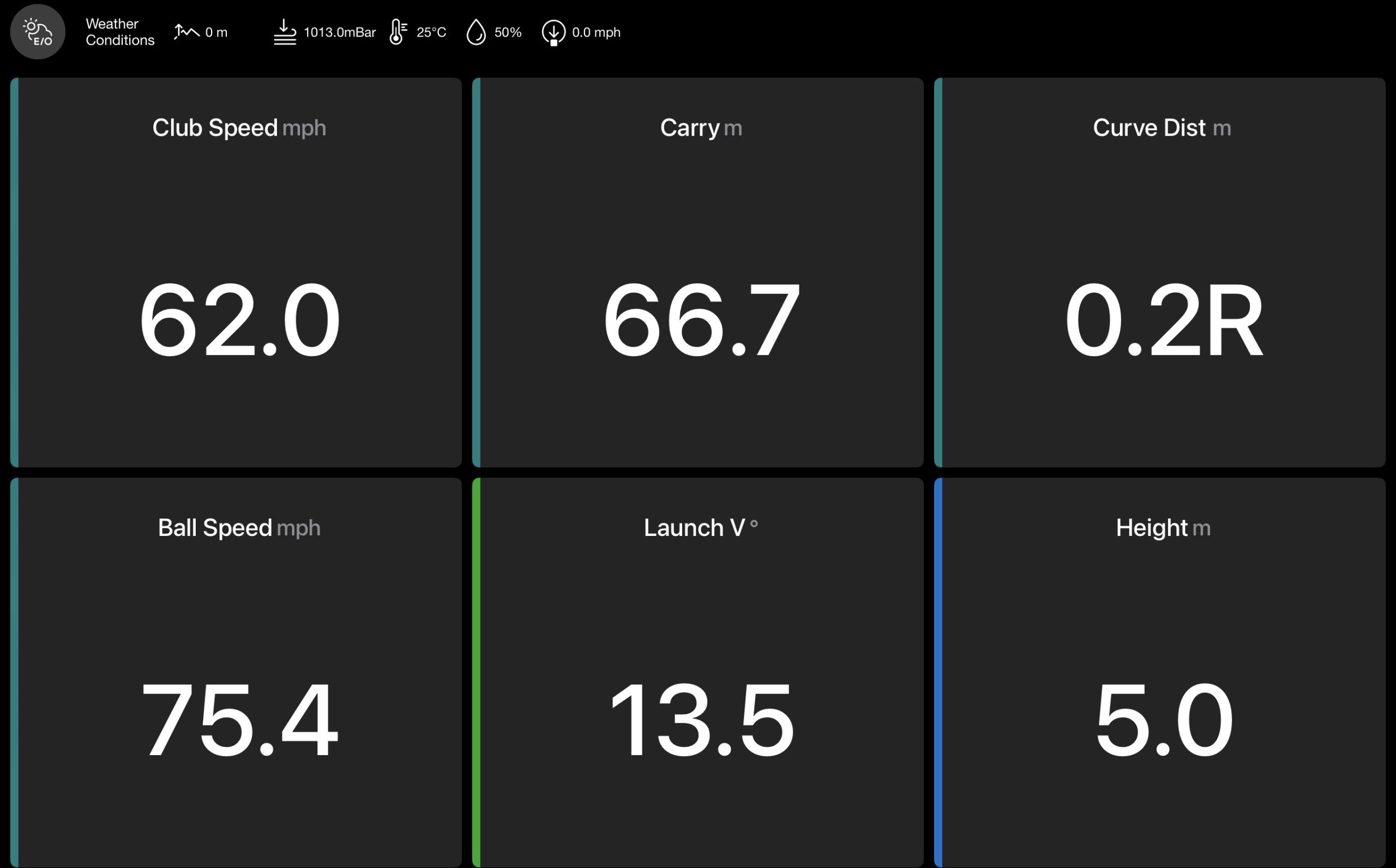
This variation changes more than carry distance. It also influences when the ball reaches a particular height.
A slower shot may lose distance sooner and remain considerably lower. A faster shot may continue to rise over a longer distance and become too high at a later boundary.
The direct comparison: With the same club, ball speed increased from 75.4 to 87.6 mph. At the same time, launch changed from 13.5 to 17.1 degrees, maximum height from 5.0 to 13.2 metres and carry distance from 66.7 to 101.0 metres.
These two shots do not show the isolated effect of one single factor. Instead, they demonstrate how strongly the actual ball flight can vary when speed, strike location, dynamic loft and ball launch change together.
We can make differences like these visible with our portable FlightScope Mevo+ radar and then compare the measured data with the golfer’s own perception.
Why one successful attempt is not yet a reliable skill
A golfer plays a low ball successfully underneath a branch. The shot works and is quickly stored as a possible new solution.
For learning, however, shots that do not behave as expected are also important. They show the golfer which parts of the prediction were accurate and which conditions changed the ball flight.
In learning research, this is connected with the concept of desirable difficulties. The term was developed by learning researcher Robert A. Bjork and describes learning conditions that can make practice more challenging initially, but may support deeper processing and better transfer over time.
Applied to golf practice, this does not mean that every difficult task or every unsuccessful shot is automatically valuable. What matters is that the task fits the golfer and that unexpected results are subsequently observed, understood and used for the next attempt.
The goal is therefore not simply to produce a neat series of identical shots on the driving range. The golfer should learn to predict different ball flights, recognise deviations and adapt the next decision.
A single successful attempt still only shows that this particular ball flight was produced once. It does not show how often the golfer can reproduce it under similar conditions.
For a narrow window, additional questions therefore matter:
- How much does launch angle vary?
- How much does ball speed vary?
- How stable is strike location?
- How large is the lateral variation?
- Which poorer strikes still remain inside the window?
A shot option only becomes reliable when the golfer understands not only the best attempt, but also the normal variation around it.
How we measure personal ball-flight height
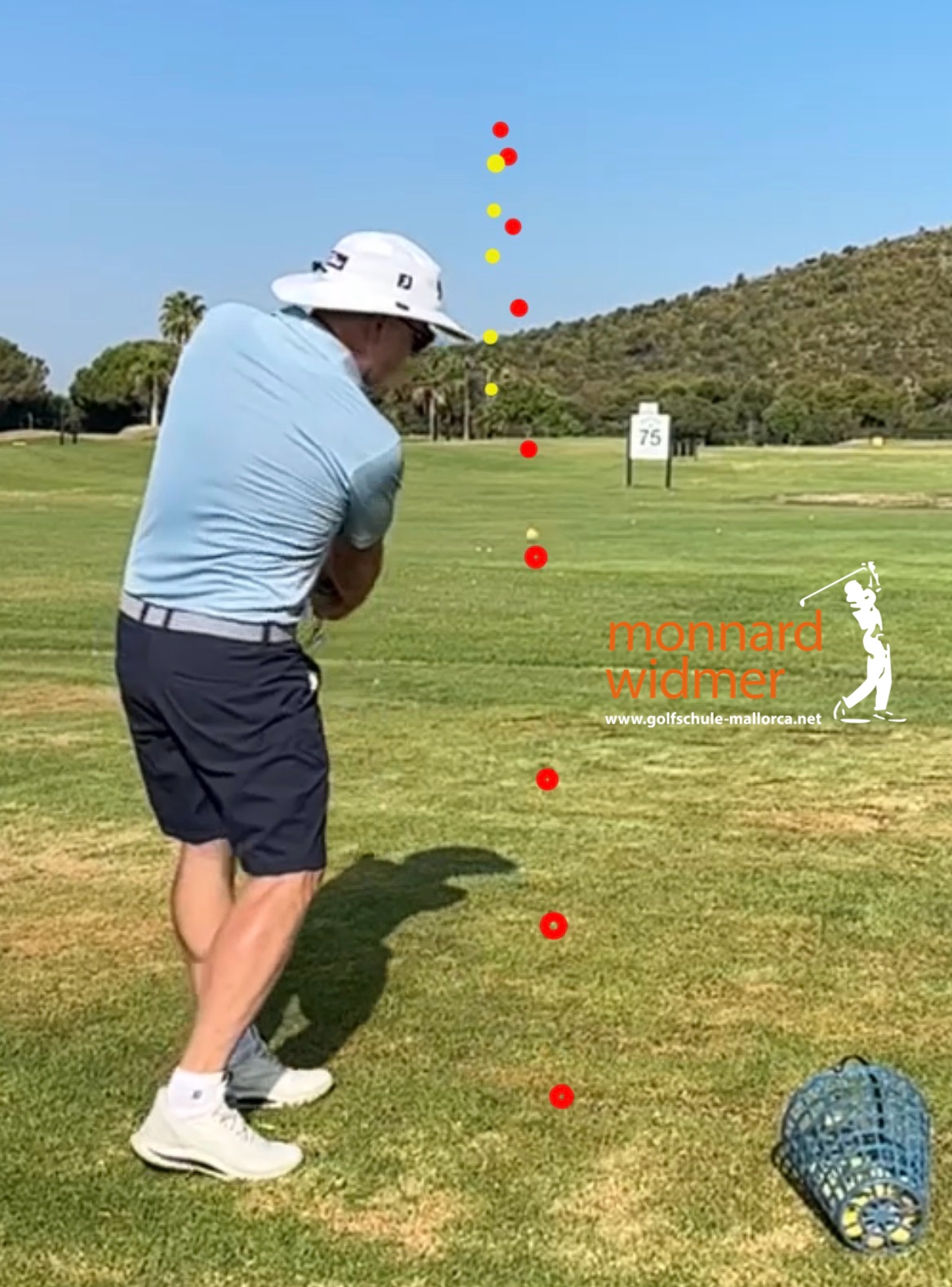
In the Practice Lab, we do not look only at individual successful shots. We compare several attempts with the same club and, where useful, connect the visible trajectory with measured data.
The golfer can first predict:
- what launch angle the ball will produce and how high it will be during the early part of the flight,
- what height it will reach at a specific distance,
- where the highest point will occur,
- and how far the ball will travel.
Several ball flights are then observed and, where useful, measured with our portable radar system, the FlightScope Mevo+.
Technology is one of our tools, not the foundation of the entire coaching process. We use measured data where it makes differences visible or supports the golfer’s perception. What remains important is that the golfer can observe and understand their own ball flight and later apply that knowledge in a real playing situation.
The measured data can help show:
- how much launch angle and early height development vary,
- how much ball speed changes,
- what maximum height is produced,
- and how much variation occurs within a series of shots.
This turns the general statement “I hit this club low” into personal information that can actually be checked.
We explain how observations like these develop into a personal repertoire of usable ball flights in the chapter Developing personal height control in golf.
This connection between prediction, observation, measurement and personal evaluation is part of our Golf Learning System.
The club name is only the beginning of the decision
Club selection remains important. It establishes a general framework for loft, length and the possible trajectory.
But in a real playing situation, the golfer needs to think further.
- What static loft does the club have?
- What dynamic loft do I normally produce?
- How stable is my strike location?
- How does the lie change the contact?
- How much do speed and launch angle vary?
- What height does the ball reach at the critical distance?
- Does a normal miss still remain inside the playable window?
This is also part of golf shot planning: the club name provides only a starting point. The golfer still has to judge whether the ball flight that is realistically available from the current lie fits the task, the available space and the acceptable margin for error.
Only this combination shows whether the planned ball flight is not just theoretically possible, but genuinely usable for the golfer.
Understanding your personal ball flight in golf lessons
The actual flight height of a club is best understood when the golfer observes several of their own shots and compares ball launch, strike location, speed, lie and height profile.
If you would like to experience our training concept yourself, we offer suitable programmes for beginners and experienced handicap golfers, as well as golfers who want to develop course strategy and decision-making more deeply through our Strategy Lab.
You do not only learn what ball flight a club can theoretically produce. You learn which height profiles belong to your personal shot pattern and under which conditions they are reliably available.
[booking]

The club has a fixed loft. The ball flight, however, is created by the loft, speed and strike the golfer actually produces in that specific shot.
The result: the golfer does not plan with the club name, but with their personal ball flight.
Professionally developed by Michel Monnard
PGA Golf Professional Michel Monnard has 30 years of experience in golf coaching, course strategy and ball-flight analysis. He teaches at Capdepera Golf in Mallorca and develops the content of the Golf Learning System from real coaching and playing situations.
Basis for this article
This article is based on observations made by Michel Monnard during golf lessons, shot series in the Practice Lab and ball-flight analyses with FlightScope. It focuses on the differences between static and dynamic loft, ball speed, strike location, lie and the resulting personal height profile. The complete measurement, training and evaluation structure remains part of personal coaching and the Window Programme.
Contents: Why golf ball-flight height changes with the same club
This part of the Playable Windows series focuses on why the same golf club can produce different ball-flight heights through changes in dynamic loft, strike location, ball speed, spin and lie, and why golfers need to understand that variation when planning shots through restricted windows.
- Playable windows in golf
An overview of how visible space, ball flight, height corridors, safety margins and on-course decisions work together. - Visible window and playable window
Why a visible opening only becomes playable when lie, ball flight, personal ability and possible finishing position are considered. - Launch windows and ball-flight height profile in golf
How launch angle, early height development and distance determine whether a golf ball can travel through a restricted opening. - Why the same golf club can produce different ball-flight heights
How dynamic loft, strike location, ball speed, spin and lie can change launch, trajectory, maximum height and distance even when the same club is used. - Safety margin and margin for error in golf
Why good golf planning needs to allow for normal shot variation rather than relying only on the perfect strike. - How to read height corridors in golf
How upper and lower boundaries, distance, rising trajectory and apex create the three-dimensional space available for a golf shot. - Planning the entire shot trajectory in golf
Why shot planning should include launch, height profile, landing, runout and the position prepared for the next shot. - Comparing prediction and reality in golf
How comparing the expected ball flight with what actually happens improves learning, judgement and future decisions. - Developing personal height control in golf
Why golfers need to understand their own height profiles, normal variation, different club trajectories and the ball flights that are realistically available to them. - Integrating playable windows into decisions on the golf course
How lie, shot pattern, safety margin, consequences and the next playing position determine whether a technically possible shot is also a sensible strategic choice.
For beginner golfers
- How beginners can get back into play from difficult lies
How new golfers can use larger openings, familiar shots and safer target areas to recover from difficult positions and prepare a normal next playing situation.
How the topic connects to our Golf Learning System
- How the Window Programme makes our Golf Learning System visible
How understanding, technical foundations, skill development, Practice Lab, Strategy Lab, technology and on-course transfer combine within one connected learning process.
[booking]


