

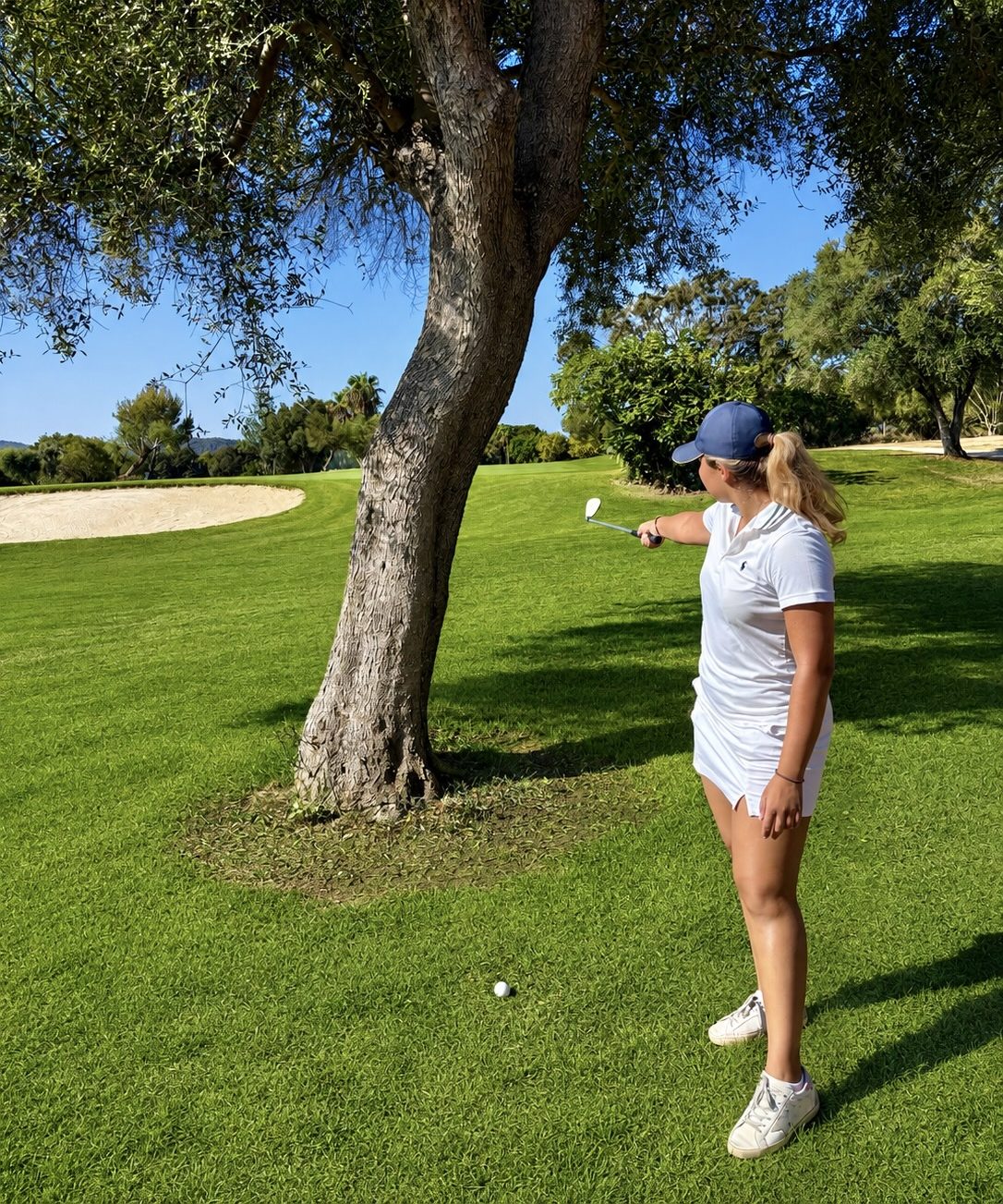
There is a gap between two branches. There seems to be enough room underneath a tree. Or between a bunker and the edge of the green, we can see a narrow area that the ball should theoretically fit through.
Situations like these quickly lead to a simple conclusion: if we can see the opening, we can play the ball through it.
But that is not enough for good shot planning.
A visible gap only becomes a playable option when ball flight, dispersion and margin for error actually fit through it.
We see an opening – the ball needs a flight path
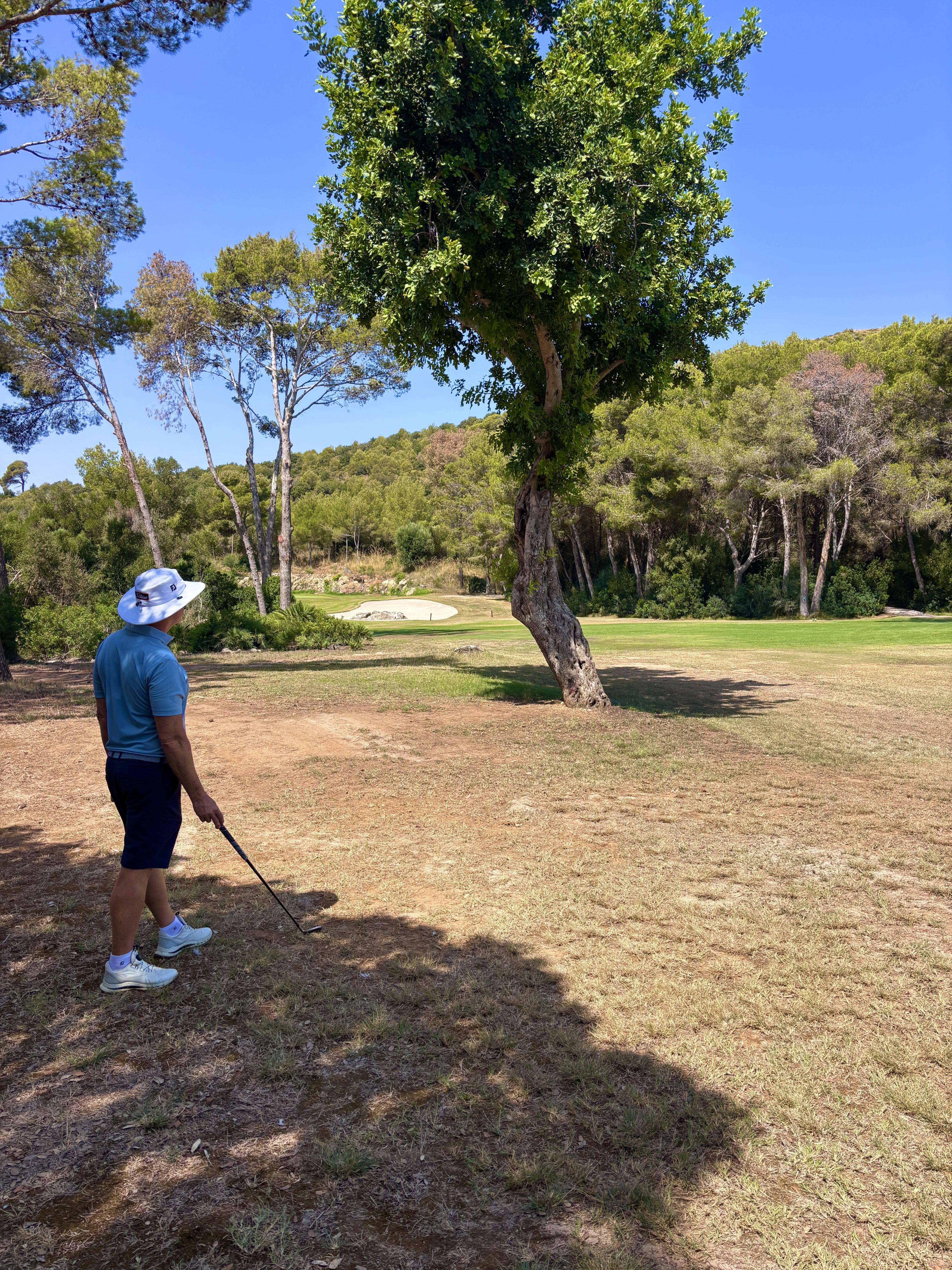
Our eyes initially judge a gap like a two-dimensional image. We see a trunk on the left, a branch on the right and open space in between.
But a golf ball does not move as a point in a straight line through this image. It launches at a certain angle, rises, reaches a certain height and then descends again.
An opening can therefore look large from the position of the ball and still be restricted by branches only a few metres farther along the flight path.
For the decision, it is not enough to consider what we can see from the ball. What matters is whether the entire required ball flight has enough space. We explain how launch angle, early height development and distance influence this available space in Launch windows and ball-flight height profile in golf.
The club changes the window
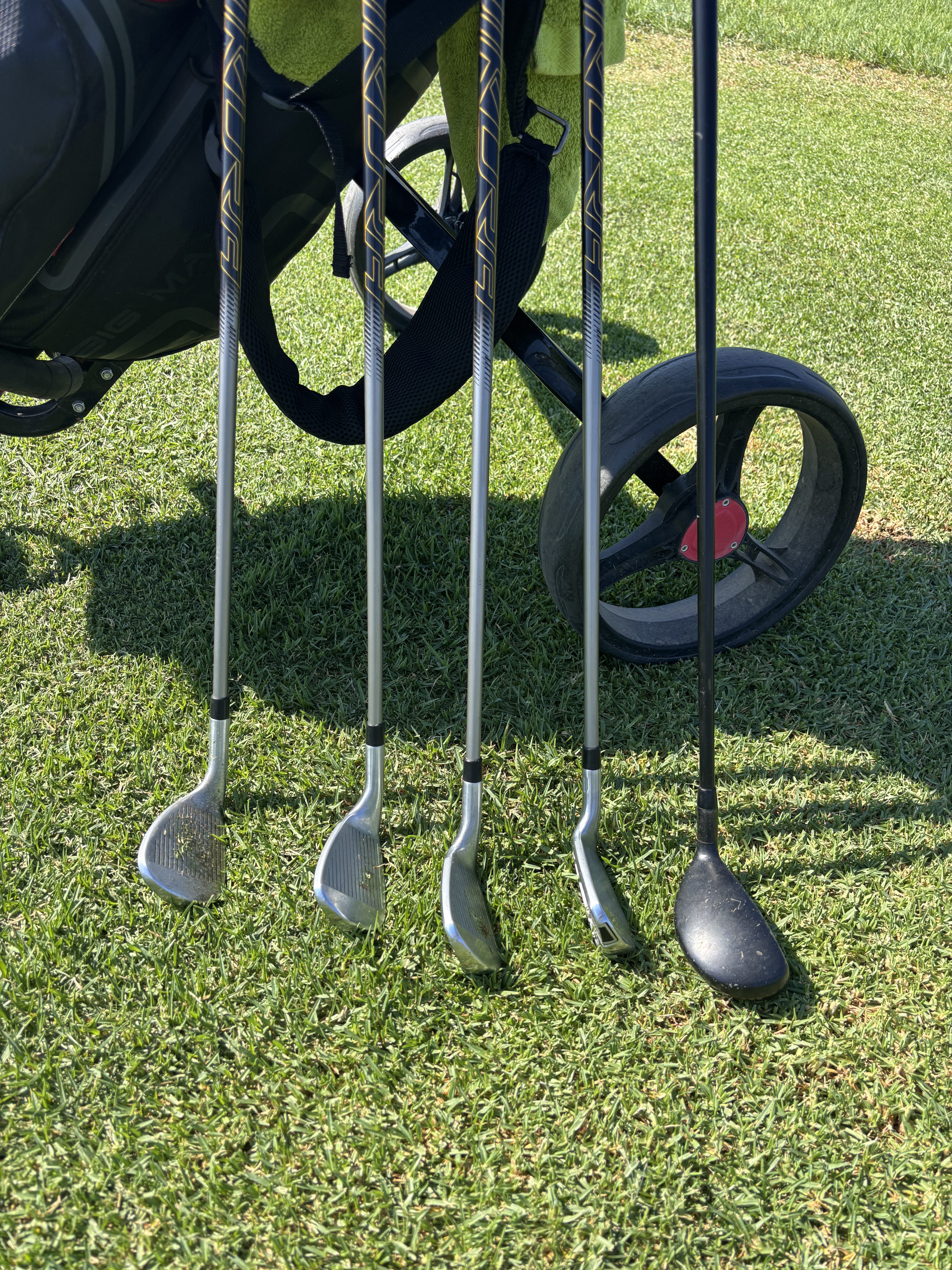
The same opening can be playable with one club and practically unusable with another.
An iron with more loft makes the ball rise more quickly. A longer club often launches lower, but may require a different flight corridor for the same direction and distance. Swing speed and strike also change the actual ball flight.
So in a difficult situation, asking “Which club goes far enough?” is not enough.
We also need to know whether the ball flight produced by that club actually fits through the available space.
A window needs room for dispersion

Even if the perfect ball fits through an opening, the decision is not complete.
No golfer starts every ball with exactly the same direction, height and speed. A slightly higher launch, a small pull or a slightly different strike can be enough to hit a branch.
A playable window should therefore not only provide room for our best shot, but also some margin for normal variation.
A window that only fits the perfect ball is not a particularly good option in many playing situations.
We explain in more detail how target zones and dispersion influence the decision in “How target zones and dispersion change golf shot planning”.
The distance to the obstacle also changes the situation

A branch one metre in front of the ball creates a different task from the same branch twenty metres farther ahead.
If an obstacle is very close to the ball, the ball may need to gain height particularly quickly or launch extremely low. If the obstacle is farther away, the flight curve has more time to develop.
The same visible amount of space above or below a branch can therefore be completely different in terms of playability depending on its distance from the ball.
The size of a playable window cannot be judged without also considering where that window is positioned along the ball’s flight path. (Read that sentence again!)
This becomes especially important when the ball has to remain below one boundary at one distance and clear another boundary later in the flight. Our article How to read height corridors in golf explains how these changing upper and lower boundaries create the three-dimensional space available for a shot.
Carry and landing are also part of the solution
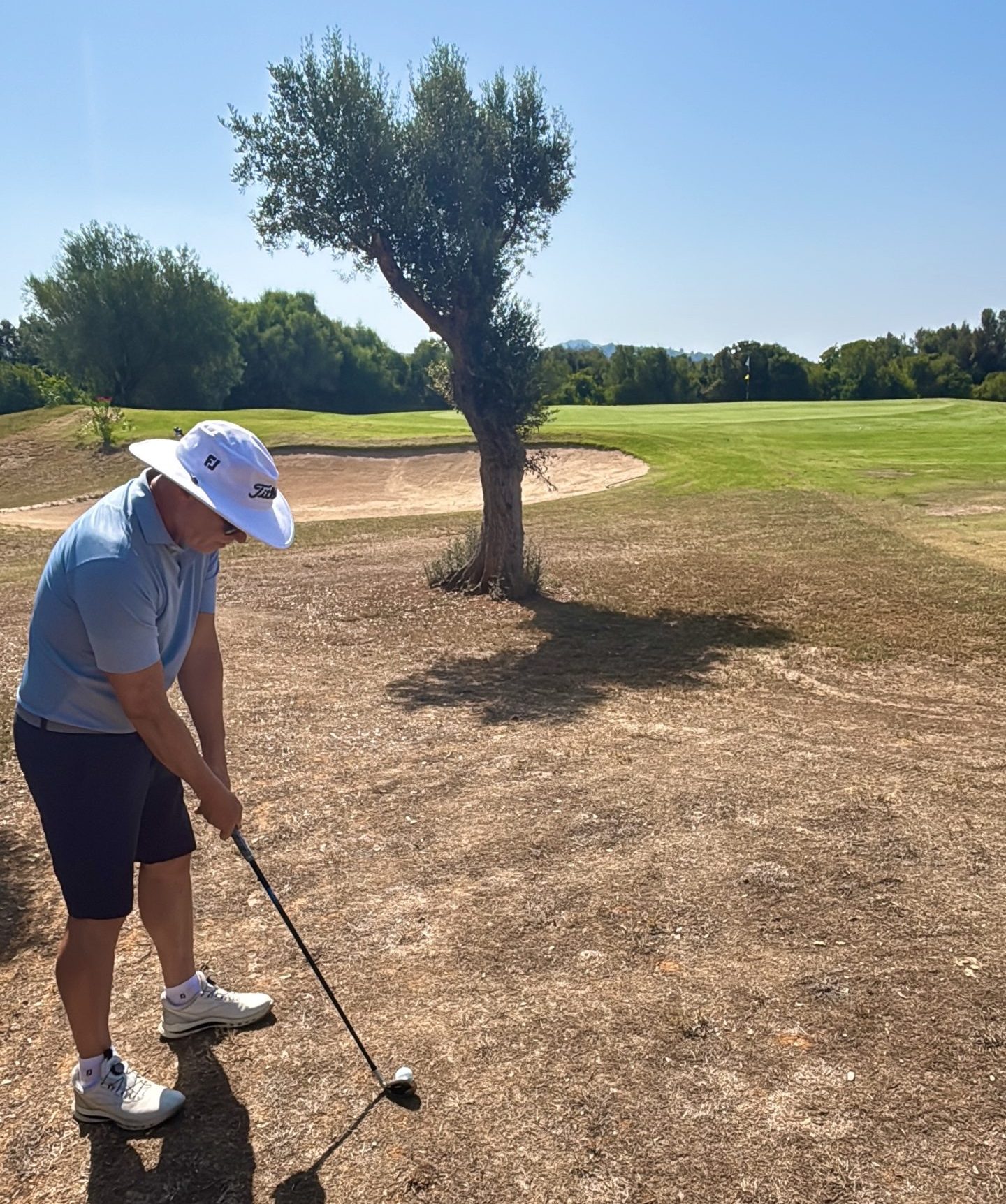
The ball does not only have to get through the window. The solution still needs to work afterwards.
A very low shot underneath a tree may pass the branches easily but then roll so far that the ball finishes in the next obstacle. A higher shot may clear the first branch but fail to carry far enough to get over rough or a bunker.
The situation beyond the visible window is therefore also part of shot planning.
An option is only truly playable when flight path, landing and roll all work together. This is why we also plan what happens after the ball has passed the first obstacle. Planning the entire shot trajectory in golf connects launch, height development, landing, runout and the final position created for the next shot.
This also connects to the task of a golf shot: getting through the opening is only useful if the shot also creates the position we actually want.
The lie can make an apparently large window smaller

The lie also determines which ball flights are realistically available.
A clean lie on the fairway can be controlled differently from a ball in semi-rough. On a slope, strike, start direction and often the flight curve change. A ball sitting down can make the desired low shot more difficult even though the visible opening appears large enough.
The lie must therefore always be part of the assessment of the available window.
We do not only assess the opening in front of us. We assess whether we can produce a suitable ball flight from this lie through that opening.
The largest visible window is not automatically the best option

There are often several options for a recovery shot. A small gap may lead directly towards the green, while a much larger opening to the side leads back onto the fairway.
The direct line may offer more distance but perhaps very little margin for error. The sideways option gains fewer metres but creates a much more normal situation for the next shot.
This brings two questions together: Is the window playable, and what situation will it create afterwards?
The best option is not automatically the one that leads most directly towards the hole.
Whether the more direct option is really worth taking depends on whether the situation offers a genuine opportunity.
We explain why the next playing situation is already part of the current decision in “Why the next golf shot belongs in the current decision”.
A shot that just succeeds can teach the wrong lesson
A particularly interesting situation occurs when a risky shot only just works.
The ball may touch the lowest branches but still roll back onto the fairway. The result is usable, and that is exactly what creates the risk of drawing the wrong conclusion.
The golfer might learn: “This gap works.” In reality, the shot may have shown that the window was too small and that the result turned out well despite the decision.
We should therefore not automatically conclude from a good result that the chosen window was sufficiently playable.
We look more closely at how to judge the decision independently from the result in “How to recognise a good golf decision after a bad result”.
Margin for error helps determine the quality of a window
A playable window should not only be technically possible. It should also fit the golfer’s dispersion and the consequences of a miss.
If a slightly higher ball only touches a few leaves, the consequence is very different from hitting a branch that sends the ball straight back into the trees. A small directional error may find open space on one side and mean a lost ball on the other.
Assessing a window therefore also means asking how much variation the situation can tolerate. The same principle is explored from the ball-flight perspective in Safety margin and margin for error in golf, where we look at how normal shot variation and personal miss patterns change the amount of space a playable solution really needs.
Playability is not created simply by having space. It requires enough space for the shot this golfer can realistically produce.
We explain how to include this margin for error in the decision in “How golfers can assess risk and margin for error more effectively”.
Playable windows can be trained
Golfers do not have to judge these situations purely by feel.

On the driving range, we can test different clubs and ball flights: How quickly does an iron rise? How low does a hybrid launch? What height does the ball reach at a particular distance? And how much does that flight vary from one shot to another?
At Capdepera Golf, we then transfer this information to real situations involving trees, branches, slopes and different lies.
Over time, the golfer learns not only to see gaps, but to assess their actual playability more accurately.
We explore the complete subject of ball-flight height, safety margins and different recovery situations in our “Playable Windows in Golf” section.
The connection to golf shot planning
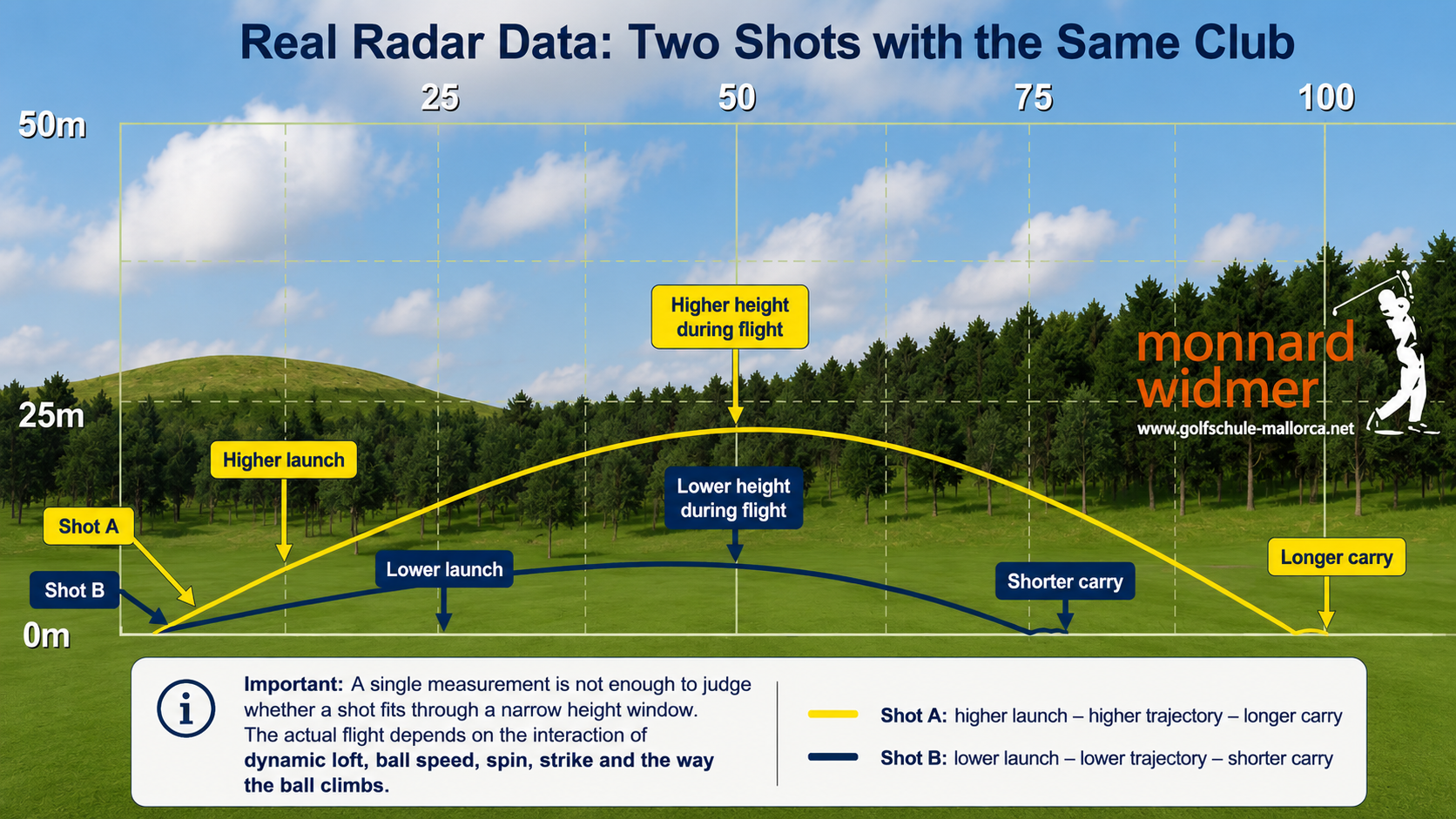
Assessing a playable window is part of golf shot planning. When an option requires a particular ball flight, we need to check whether the available space fits the club, lie, dispersion and possible misses.
Only then can we sensibly decide what task the shot should have and which target zone is actually realistic.
An option only belongs in our shot plan when the required ball flight has enough space and the possible variations remain acceptable.
Training playable windows in our advanced golf course
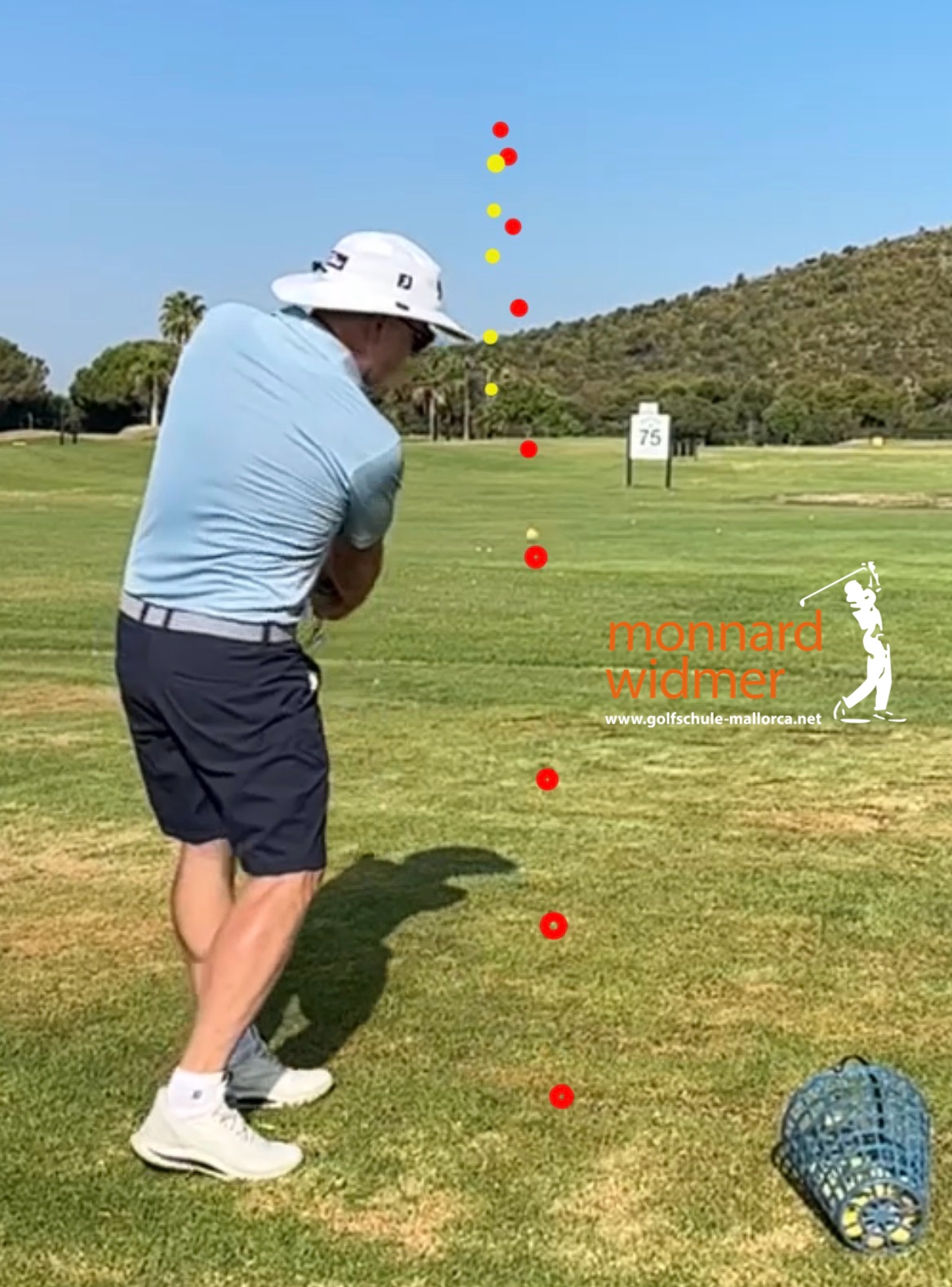
These are exactly the kinds of situations we train in our advanced golf courses at Capdepera Golf. We compare visible openings, test different clubs and consider which ball flight actually provides enough margin for error.
On the driving range, we can first observe and test the ball flights required for these situations. On the golf course, the golfer then has to combine this information with the lie, obstacles, dispersion and the desired situation for the next shot.
The goal is not for the golf instructor to assess every window for the player. Over time, the golfer should learn to recognise which openings are genuinely playable and when another option makes more sense.
Learn more about this approach to golf instruction in our advanced golf course for handicap golfers in Mallorca.
[booking]
Golf shot planning – an overview of the topics
A visible gap is not automatically a playable option. Good golf shot planning also needs to consider whether the required trajectory fits the available height and width, whether the lie allows that ball flight and whether there is enough margin for the golfer’s normal variation.
The following articles show how playable windows connect with the wider decision-making process: defining the task of the shot, recognising genuine opportunities, choosing realistic targets, accounting for dispersion, assessing risk and preparing the next playing position.
Golf shot planning
The main overview explains how golfers combine situation analysis, target selection, dispersion, risk, ball flight and margin for error when planning a shot.
What is the task of a golf shot?
The task of the shot helps determine which trajectory is actually required. In some situations the best objective may simply be to return the ball safely to a more playable position.
When is a golf shot really an opportunity?
A route through or around an obstacle only becomes a genuine opportunity when the available window is large enough for both the intended ball flight and the golfer’s normal variation.
Why the best possible result is not always the right target
The most ambitious route may offer the best possible outcome, but a wider or simpler window can produce a more realistic and useful result.
Why the next shot belongs in the current decision
Choosing a playable window should also consider where the ball is likely to finish and what distance, angle and lie that position will create for the next shot.
How target zones and dispersion change golf shot planning
A window needs enough room not only for the intended trajectory, but also for variation in starting direction, height and overall shot pattern.
How golfers can assess risk and margin for error more effectively
The closer the planned trajectory runs to branches, bunker edges or other critical boundaries, the smaller the margin for error and the greater the precision required.
How playable windows influence golf shot planning
The current article explains how golfers can judge whether a visible route is genuinely playable by combining trajectory, available space, lie, dispersion and safety margin.
How to recognise a good golf decision even after a bad result
A ball can still strike a branch or miss the intended window after a sensible decision. The quality of the choice depends on whether the window offered a realistic margin before the shot was played.


