


A good golf shot can produce a bad result. And a risky or poorly planned shot can still produce a good result.
That is exactly why we should not judge the quality of a decision only by where the ball eventually finishes.
If we want to learn from a round of golf, we need to separate three things after the shot: Was the decision sensible? Was the execution good? And how much of what happened was simply the actual outcome?
A bad result does not automatically make a good decision wrong.
Outcome and decision quality are not the same thing
Imagine an approach shot. There is water to the left of the green and plenty of space to the right. The golfer therefore chooses a target zone slightly farther to the right.
The ball still starts farther left than normal and finishes in the water.
The result is bad. The decision before the shot may still have been correct if the target zone, dispersion and costly side of the miss were considered sensibly.
We should therefore not work backwards from the result and use it alone to judge the quality of the decision.
This is why target zones and dispersion should be judged from the plan made before the shot, not only from where one individual ball eventually finishes.
A good outcome can also come from a bad decision

The opposite happens just as easily.
A golfer plays through a very small gap between trees. The ball catches a branch, gets a favourable deflection back onto the fairway and finishes in an excellent position.
On the scorecard, the outcome looks good. But it would still be dangerous to learn from it: “This shot works.”
A good result does not automatically prove that the decision behind it was good.
In situations like this, it helps to distinguish between a visible opening and a genuinely playable window within golf shot planning.
After the shot, evaluate the decision first

After a shot, it helps to look briefly at the situation again from the perspective of the original plan.
Was the chosen target zone sensible? Did the shot suit the lie and the situation? Was there enough margin for error? And would a normal miss still have produced a usable next situation?
If most of these questions can be answered with yes, the decision may have been good even if the individual shot produced a bad result.
The first question after a bad result should therefore not be: “Why did I do that?” It should be: “Was the plan sensible and the execution poor, or was the plan itself the problem?”
Then we look at the execution
A good decision does not guarantee a good shot.
The ball may be struck thin, curve more than expected or finish significantly shorter than planned. Perhaps the swing was poor, perhaps the strike or simply the start line was the problem.
These are execution errors. They should not automatically cause us to change a fundamentally sensible strategy the next time we face a similar situation.
If the plan was good and only the execution was poor, we do not necessarily need to change the decision.
Sometimes a bad shot reveals a problem in the planning
Not every poor shot should simply be explained away as “bad execution”. Sometimes the problem already existed in the preparation of the shot.
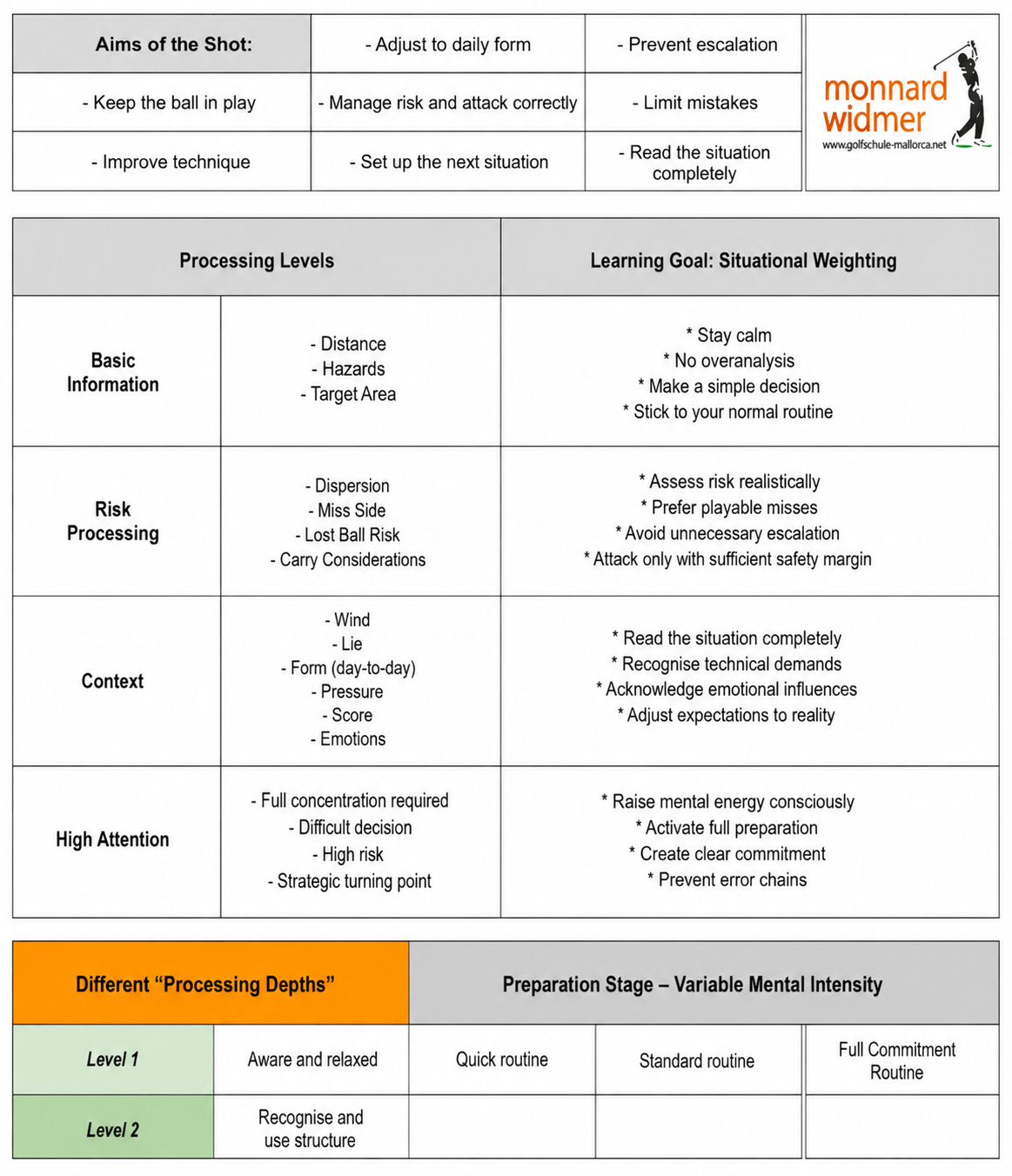
That is why our shot-planning documents distinguish between different levels. We begin with basic information such as distance, hazards and target area.
Depending on the situation, dispersion, possible miss sides, lost-ball risk, wind, lie, current form, score or pressure may then become relevant. For particularly important or risky shots, the required level of attention increases again.
If a normal deviation already sends the ball into the water, a recovery window is only large enough for a perfect shot, or the chosen distance hardly fits the golfer’s actual dispersion, a poor result may therefore reveal a problem in the planning.
We need to distinguish between something that was executed unusually poorly and a situation in which important information was not sufficiently considered before the shot.
That is exactly why shot planning should not mean thinking about as much as possible before every ball. A simple situation should be allowed to remain simple. The important skill is recognising when risk, context or the possible consequences of a miss require more careful preparation.
We look more closely at how much variation a situation can tolerate in “How golfers can assess risk and margin for error more effectively”.
Our expectation before the shot becomes the benchmark afterwards
Evaluating a shot afterwards becomes much easier if we had a realistic expectation beforehand. What would have been a very good shot? What do we normally expect? Which deviation would still have been acceptable? And which outcome do we particularly want to avoid?
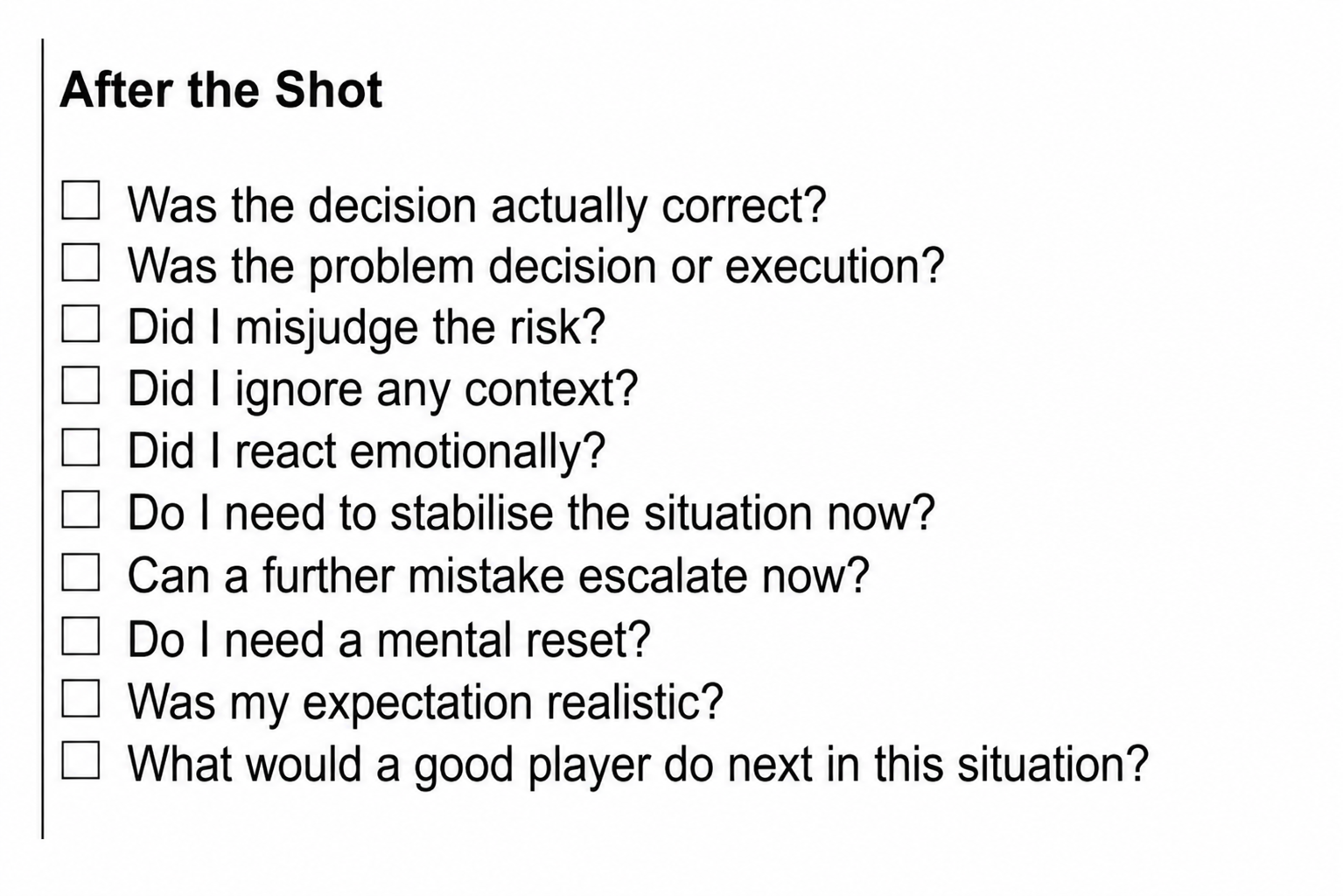
After the shot, we can compare that expectation with the actual result. But we are not only interested in where the ball finished. We also ask whether the decision made sense, whether the problem was in the execution, whether risk or context was assessed incorrectly and whether our expectation was realistic in the first place.
This turns the result into information: we try to understand what this shot can teach us for the next similar situation.
Without a realistic expectation before the shot, it is easy to judge an outcome too harshly or too generously afterwards. A poor shot does not automatically mean a poor decision, just as a good result does not prove that everything was assessed correctly beforehand.
We look more closely at how much variation a situation can tolerate in “How golfers can assess risk and margin for error more effectively”.
One shot does not create a new pattern
Another mistake occurs when we immediately create a new rule from a single result.
A hybrid flies unusually low once. An iron goes well right once. Or an aggressive shot happens to work exactly when we try it.
These pieces of information are interesting, but one ball does not automatically tell us what that shot normally looks like.
Only when certain deviations begin to repeat do they become information that should have a stronger influence on our future shot planning.
We learn from every shot, but we do not change our strategy because of every individual shot.
A recurring miss belongs in the next decision
If the same miss occurs several times during a round, the situation changes.
Perhaps the driver is consistently starting right that day. Maybe an iron is flying shorter than normal, or a particular shot from the rough is proving more difficult to control.
We now have new information about our current game. That information should be considered in the decisions that follow.
Good shot planning works not only with the golfer we normally are, but also with the golfer who is actually standing on the course that day.
This is part of the wider golf decision process: new information from the round should influence the next decision when it becomes relevant.
Emotions can also change how we evaluate a shot
After a poor shot, an objective assessment is not always easy.
A ball in the water feels different from a ball in the middle of the green. As a result, we tend to judge the decision behind a bad outcome particularly harshly, while quickly justifying a risky decision that happened to turn out well.
This is exactly where a clear separation between decision and outcome helps.
The result should influence our analysis, but it should not completely determine it.
A simple review after an important shot
After an important or particularly costly shot, three short questions can help:
Was my decision sensible?
Was my execution approximately normal?
What should I learn from this result for the next similar situation?
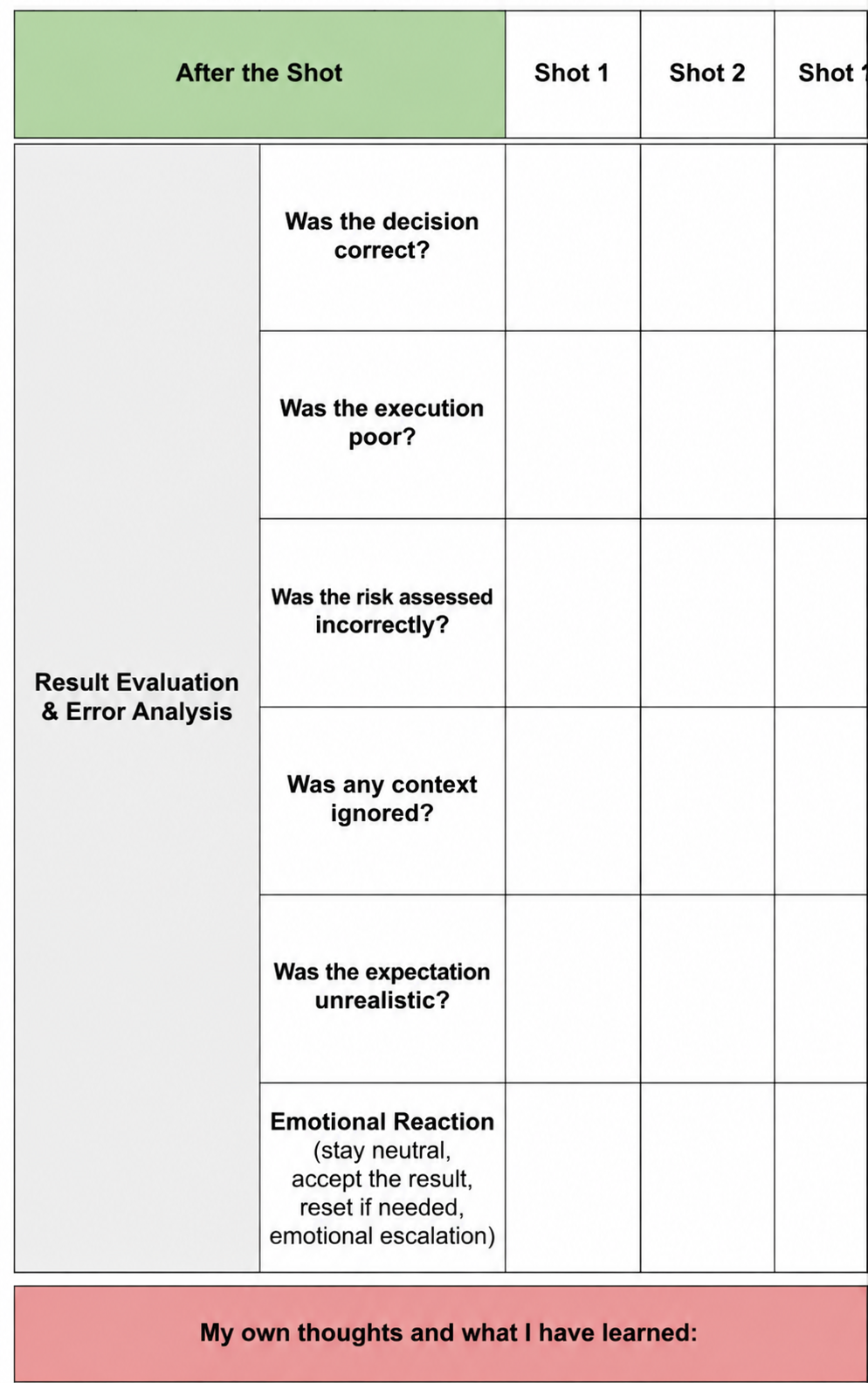
Often, this short review is enough. But if a situation was particularly important or the same mistake keeps occurring, we can look more closely.
We can then examine, for example, whether the risk was assessed incorrectly, whether important contextual information such as the lie, wind or slopes was overlooked, or whether the expectation before the shot was unrealistic. The emotional response also matters: Does the golfer remain objective, accept the result, or does the reaction already create the risk of another mistake on the next shot?
The emotional response also matters: Does the golfer remain objective, accept the result, or does the reaction already create the risk of another mistake in a developing chain of errors?
The purpose of the review is not to spend longer thinking about the previous shot. It is to extract the right information for the next one as quickly as possible.
In this way, a poor shot does not automatically become frustration. It becomes information we can use for the next decision.
At the beginning of the learning process, a golfer needs a lot of feedback. They need to learn which information matters in a situation, where to direct their attention and how to weigh distance, lie, hazards, dispersion, risk and context.
As experience grows, the role of the golf coach changes. The golfer should increasingly be able to recognise which information is relevant, which decision fits the situation and what can be learned from the result for the next shot.

We don’t give you the fish. We teach you how to fish.
Our goal is not to keep giving the golfer the right answer. We want to help them reach the point where they can increasingly find that answer for themselves.
The connection to golf shot planning
Shot planning does not end with the decision before the shot. The evaluation afterwards is also part of the learning process.
Within our golf shot planning approach, we therefore distinguish between planning, execution and the actual result. This makes it easier to recognise whether a future decision should be adjusted or whether a single shot was simply executed poorly.
Good golf shot planning does not mean always predicting the correct result. It means making a sensible decision from each situation and then taking the right lesson from the outcome.
We also explore how expectation, shot planning and outcome interact in the Golf Learning Insight “A good golf score cannot be forced”.
Reviewing decisions in our advanced golf course

This is exactly the distinction we practise in our advanced golf courses at Capdepera Golf, directly in real playing situations. After an important shot, we do not only look at the result. We compare the original decision with the actual execution.
Was the target zone sensible? Did the level of risk fit the situation? Was there enough margin for error? Or did a normal miss reveal that the plan should be adjusted?
Over time, the golfer learns to evaluate their own decisions more independently and extract the right information from both good and bad results.
You can learn more about this form of golf instruction in our advanced golf course for handicap golfers in Mallorca.
[booking]
Golf shot planning – an overview of the topics
A poor result does not automatically mean that the decision was poor. Good golf shot planning separates the quality of the decision from the quality of the execution and from the final outcome of the shot.
The following articles show how decision quality connects with the wider shot-planning process: defining the task, recognising opportunities, setting realistic expectations, choosing target zones, assessing risk, considering playable windows and preparing the next position.
Golf shot planning
The main overview explains how golfers combine situation analysis, target selection, dispersion, risk and expected outcomes before making a decision.
What is the task of a golf shot?
Evaluating a decision starts with the task. A shot can only be judged properly if we first know what the golfer was trying to achieve.
When is a golf shot really an opportunity?
An aggressive decision should be judged by whether the situation genuinely offered enough reward and tolerance before the shot, not by whether the ball happened to finish well.
Why the best possible result is not always the right target
Realistic expectations make post-shot evaluation more useful because the decision can be compared with a range of possible outcomes rather than only the perfect result.
Why the next shot belongs in the current decision
A decision can also be evaluated by the position it was intended to create and whether the plan gave the golfer a reasonable chance of simplifying the next shot.
How target zones and dispersion change golf shot planning
A ball finishing outside the target zone does not prove that the target was wrong. Dispersion means that sensible decisions can still produce imperfect results.
How golfers can assess risk and margin for error more effectively
Good post-shot analysis asks whether the chosen option offered an appropriate margin for error and whether the possible consequences were assessed realistically before the shot.
How playable windows influence golf shot planning
A ball can miss a branch or fail to pass through a planned window even when the route itself offered a realistic trajectory and sufficient margin before the shot.
How to recognise a good golf decision even after a bad result
The current article explains how golfers can separate decision, execution and outcome so that one bad result does not automatically lead to the wrong lesson.


