

Why attack is often misunderstood in golf

Many golfers associate good golf with attack. Attacking flags, playing through narrow gaps or trying to win a hole with one exceptional shot.
In reality, good and more so stable scores rarely come from spectacular attacks. They come from decisions where the level of risk matches the situation.
This is why understanding when to attack in golf is not about courage, but about making decisions that actually hold up over time.
Attack is not wrong in itself. It is simply used at the wrong moment far too often. Risk decisions are a central part of golf strategy and of effective golf risk management.
The key difference is not the player’s courage, but whether the risk is actually justified.
Attack is not the goal. The right decision is.
Risk decisions are part of a broader system in our Strategy Lab. For a complete overview of the key strategic building blocks, see
–> Golf Strategy Fundamentals
Risk vs reward in golf
An attacking decision in golf starts to make sense when the potential benefit is greater than the risk it creates.
However, many attacks are driven by other factors:
- because the shot seems possible
- because the player feels confident
- because a previous mistake should be recovered
- because the flag looks tempting
- because it has worked in the past in practice rounds
These decisions are rarely based on a structured evaluation.
Strategic golf works differently. It asks a simple question:
Is this attack statistically justified – or emotionally driven?
When an attack is truly justified
An attack in golf is not automatically aggressive. It is a decision where increased risk is consciously accepted because the situation offers a clear advantage.
Typical characteristics of a justified attacking situation are:
Strategy Lab rule for risk control
- your dispersion does not automatically bring hazards into play
- the target zone offers enough space
- a possible miss remains playable
- the potential benefit justifies the risk
If these conditions are met, an attack can make sense. If they are missing, an attacking decision often becomes statistically expensive.
Strategy Lab rule: An attack only makes sense if your normal miss does not immediately lead to a major problem. This simple rule helps many golfers evaluate risk more realistically and connects directly to safe miss planning.
How to evaluate attacking decisions
Whether an attack makes sense depends mainly on two factors: dispersion and target zone.
Dispersion shows how shots actually spread. The target zone defines the area where the ball can land without immediately creating a major problem.
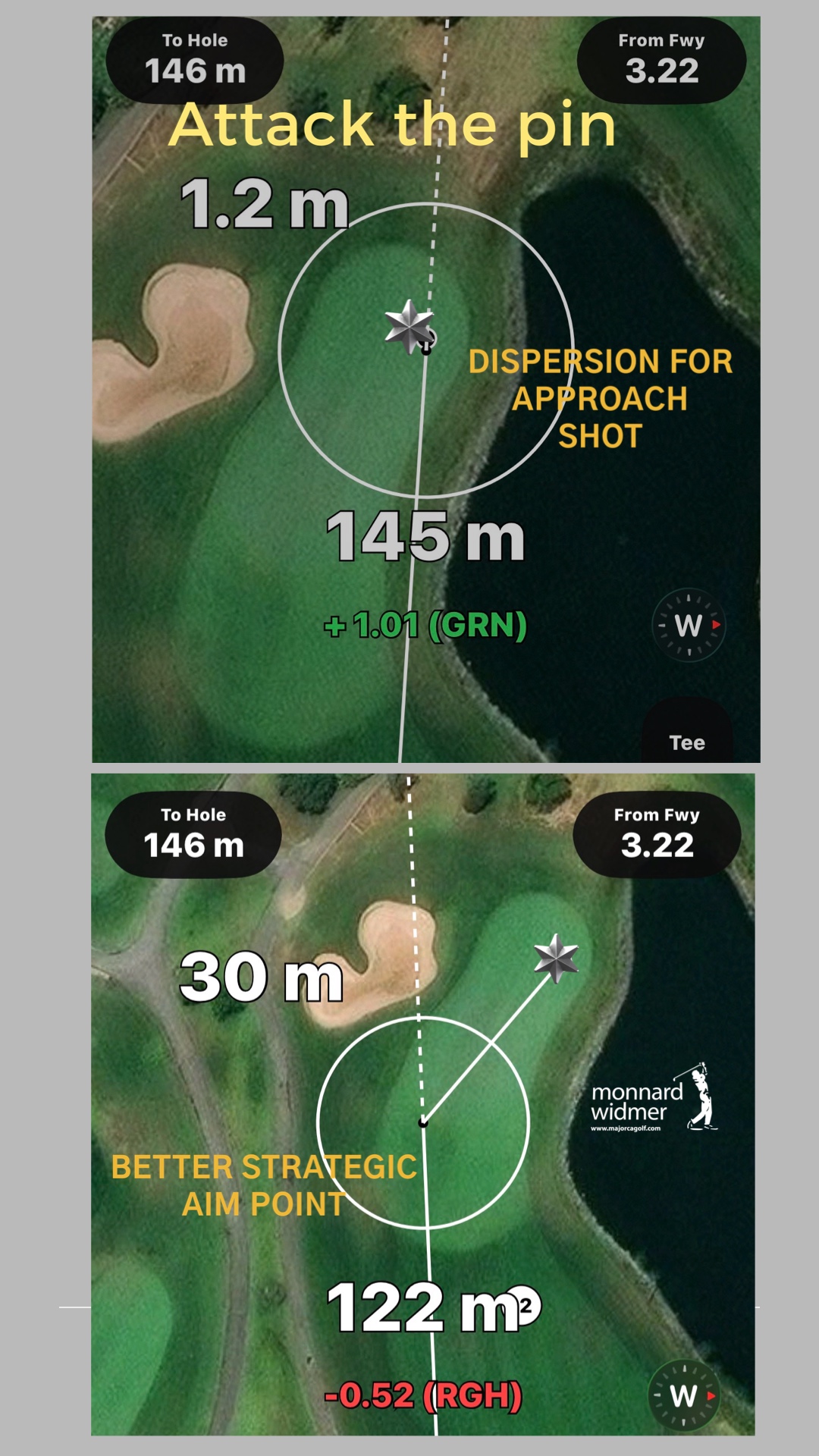
If a player’s dispersion touches hazards such as water or bunkers, an attacking decision quickly becomes risky.
Strategic players therefore consider their real shot pattern and choose a target zone where a normal miss remains playable.
More on dispersion → Golf dispersion – Why honesty improves your strategy
How target zones are chosen → Playing to zones – Why better scores come from better areas
Strategic players do not aim directly at the flag. In this example, the target zone is even on the opposite side of the green: aiming line at the right bunker edge, about 122 meters instead of 144 meters to the flag. The key is not the exact point, but a target zone where a normal miss remains playable.
In practice, many golfers are surprised by how wide their real dispersion is. During lessons, we often measure and observe this directly on the course. Only when players see how their shots actually spread does it become clear why target zones matter more than the flag.
This is often referred to as course management, but in practice it is about making clever decisions based on your real shot pattern.
This is how we build decisions that hold up on the course.
Why good golf is not passive

Rule based strategy does not mean playing defensively all the time. On the contrary, it helps you recognize attacking opportunities more clearly.
When a situation is favorable, the attack is played consciously, not out of hope, but with conviction.
The difference is that attacking decisions are no longer random, but based on a clear decision logic. This creates a game that looks calmer, but handles opportunities more precisely.
Attack is a tool, not a reflex
A good golfer does not automatically attack when an opportunity appears. First, they recognize whether it is truly an opportunity. The goal of strategic golf is not to avoid risk.
The goal is to use risk where it creates a real advantage.
This is why attack in golf is not an expression of courage, but of understanding.
How attack is trained in our Strategy Lab
In the Strategy Lab, attacking decisions are not treated in isolation.
Golfers first learn to:
- understand their dispersion
- define realistic target zones
- recognize risk
Only then is it decided when an attack makes sense. These decisions are not fixed. They depend on the situation. This is where situation rules become important.
These decisions are not only discussed, but tested directly on the course. Players experience which decisions stabilize their game and which ones create unnecessary mistakes.
This builds a level of understanding that leads to better scores over time.
A simple decision question
Before any attacking decision, it is worth asking: Will a miss still be playable – or does it immediately create a major problem?
If an attack fails, the reaction afterwards determines the score. How to stabilize after mistakes is explained in Stabilization after mistakes.
The next step

Attack in golf is only one part of a broader strategy.
What matters is not only when to attack, but also how you handle difficult situations.
Many players believe that good golf means making as many birdies as possible.
Statistically, however, a different picture appears. Good rounds are mainly created by avoiding big mistakes.
Strategic golf is not about forcing opportunities. It is about playing situations in a way that a normal miss does not cause major damage.
Good scores rarely come from spectacular shots. They come from decisions where a normal miss remains manageable.
This is exactly why the Strategy Lab works with rules based golf strategy.
Strategic decisions do not happen by chance
Attack in golf does not mean playing bravely. It means recognizing situations where risk is statistically justified.
The foundation for this are two core elements: understanding your dispersion and choosing realistic target zones.
Golfers who understand this make decisions that work over many rounds.
Good golf is not created by spectacular shots, but by decisions that remain stable when repeated.
This is exactly the mindset we develop in our golf courses. Many players realize that their scores improve not through spectacular shots, but through decisions that hold up over many holes.


