
Why one mistake often leads to two or three more

Many bad holes in golf are not caused by a single mistake. They are caused by the reaction to that mistake.
After a mistake, the next step is often defined by where the previous miss finished. This is why safe miss planning plays a key role in avoiding big numbers.
A pulled tee shot, a poor chip or a missed putt is only one event. What really matters is how the next shot is played.
This is where many golfers lose their structure.
They become quicker, more emotional or more aggressive in their decisions. The attempt to fix the mistake immediately often leads to a second risk. What started as a small error turns into a chain of mistakes.
Stabilization after mistakes in golf is one of the key skills that separates stable scores from volatile rounds.

Stable golf is not about avoiding mistakes.
Stable golf is about restoring control after a mistake.
Stabilization is a key part of the golf decision process and a core element of our rule-based golf strategy.
How to recover after a bad shot

After a mistake, the mental state often changes.
Frustration, tension or the urge to recover immediately take over. That is exactly why this moment needs a clear rule.
The rule is simple: Do not attack after a mistake.
Depending on the situation, the correct next step can vary. These adjustments are part of situation rules.
The next shot has only one purpose: bring the situation back under control.
This can mean:
- accepting a distance instead of forcing a perfect position
- getting the ball back into play
- choosing a safe target zone
As a golfer, you need to recognize when the situation is stable again. Only then does attacking make sense again. The shot directly after a mistake is not the moment to take risk.
This simple rule prevents many big numbers.
Why most golfers struggle to follow this rule
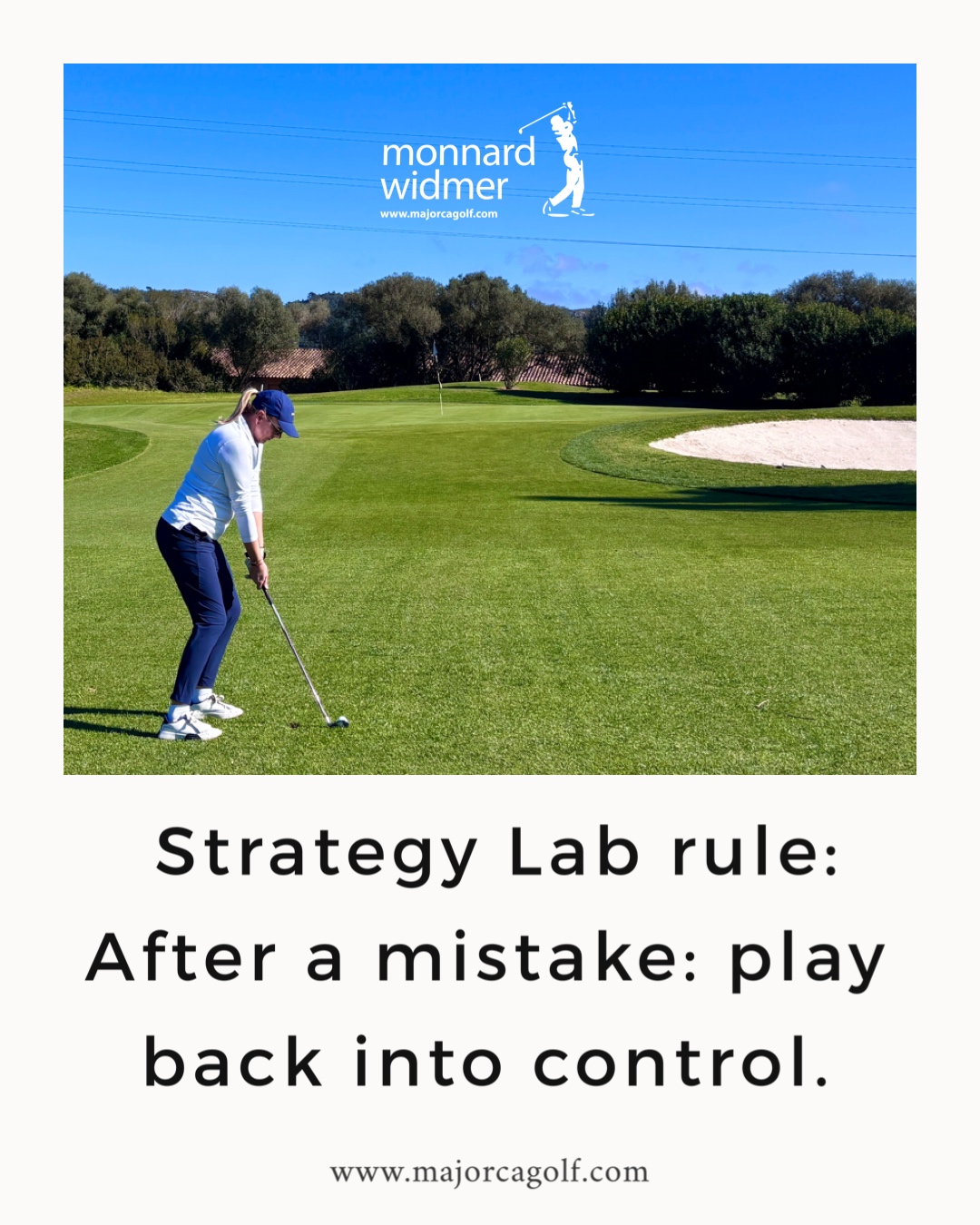
The problem is rarely a lack of knowledge. Most golfers understand that a risky shot after a mistake can be dangerous.
The problem is emotional pressure. This is where the mental game in golf mistakes becomes critical.
The thought appears: I need to fix this now.
This changes the decision. The player chooses a more aggressive line, a more difficult shot or a target outside their realistic dispersion.
That is why in the Strategy Lab we work with clear decision rules, not with spontaneous judgement.
Rules are more stable than emotions.
Stabilization is a strategic step
In many sports, there is a moment where control must be restored before attacking again.
In golf, this moment is critical because every shot creates a new situation.
Good strategy is not only about attacking. It is about moving between three states:
- Attack
- Stabilization
- Defence
Most golfers recognize attacking situations.
Most golfers also recognize when they need to play safe
What is often missing is patience. After a mistake, the instinct is to recover immediately. This is exactly what creates the next problem. Stabilization means waiting until the situation allows a good decision again.
In the Strategy Lab, we describe this simply:
Mistake → Stabilize → Patience → Opportunity
The stabilization shot is often overlooked. Yet it often decides whether a hole can still be saved.
Stabilization is one part of a broader strategy system.
Learn how it fits together with dispersion, target zones and risk decisions in
👉 Golf Strategy Fundamentals
[booking]
Why the next decision matters most
To recognize this moment, one simple question helps:
Am I trying to fix the mistake right now?
If the answer is yes, the next shot is likely too aggressive.
In that moment, use a simple rule:
Play back into control first.
“No risk no fun” is not a strategy. It is hope. Once the situation is stable, normal play can continue.
Stabilizing your round under pressure
Players with stable scores do not necessarily make fewer mistakes. They react better to them.
They accept the situation, reduce risk and bring the ball back into control. That is how they avoid big numbers.
In reality, difficult situations will always occur. A bad lie, a missed shot or a poor chip is part of the game. The difference is how you respond.
In practice rounds, this can be trained deliberately. Not just hitting good shots, but working on the reaction after mistakes.
Once this reaction becomes stable, the emotional pressure during a round decreases.
You already have a plan.
Stable golf is not built on perfect shots. It is built on controlled decisions after mistakes. That is the foundation of any sound golf recovery strategy.
Stabilization as part of your strategy

In the Strategy Lab, stabilization is a fixed part of decision making. Mistakes are part of golf. The key is learning how to restore control after them.
Golfers who recognize this moment prevent many big numbers. Stabilization is not weakness. It is a strategic step back into control.
One of the core ideas is simple: It is not about making more birdies. It is about avoiding doubles and triples.
Many of the ideas here connect to other fundamentals such as dispersion, target zones and rule based decisions.
These concepts are trained systematically in the Strategy Lab, where decision making and stabilization are practiced directly on the course.


